
I appreciate that for some time now a number of you lovely folk following our little venture have been asking me to publish an update for the project, to which I have been replying please be patient, as I will do so when I feel the timing is about right. Well all things considered I guess that time is now upon us, so here we go folks.
Just as a heads up prior to going any further please be aware that given the length of time since I last wrote a diary update, there was with this one a fair amount to write down such that it appears that I have accidentally written a novel. Accordingly I fully appreciate that for some of you it may be a case of TLDR (Too long didn’t read) so for the literary window shoppers amongst us I have included a selection of photos for which I trust at least some of them may be of interest to you.
For those that do have sufficient interest and who don’t mind a fair amount of reading, then may I suggest you make yourself a brew, pull up a chair and let us pick up from where we left off at our last update.
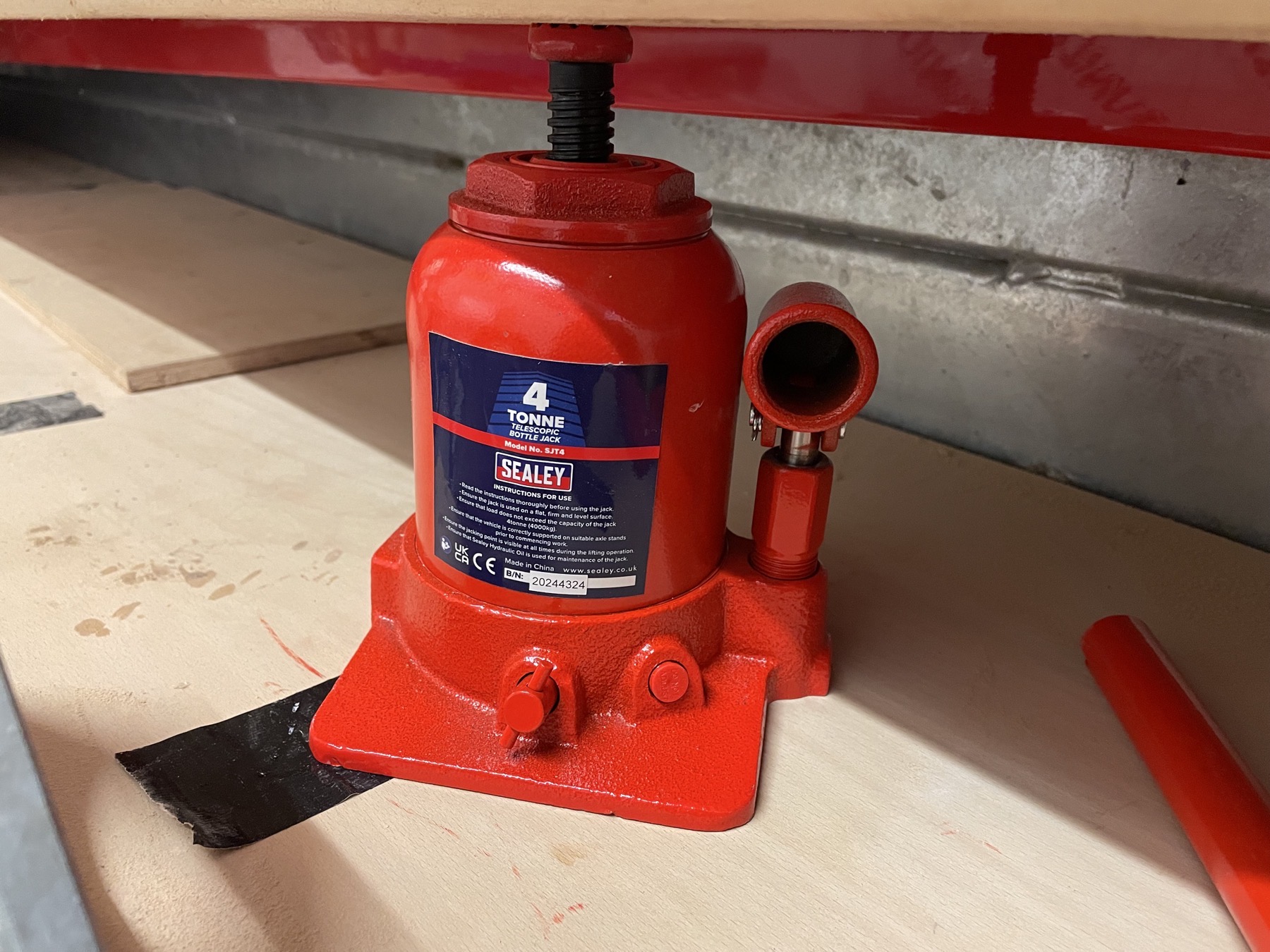
In the first instance Steve Buckle of our sponsor Sealey Tools kindly sent us a set of their SJT4 telescopic bottle jacks, each with a 4 tonne capacity which were simply perfect for raising our jet hydroplane Longbow marginally up off her trailer bed in order to insert and then gently lower her back down onto load cells (generously sponsored by Novatech) placed beneath the aft end of each of her three planing shoes. From the values obtained with these load cells our design engineers at AFD Systems were then able to calculate the centre of gravity for the craft in its current form. This will be an ongoing exercise as the build continues so we are able to monitor by how much the centre of gravity shifts from where it is now, as and when various parts are added to the boat.
Sealey Tools also kindly allowed us to provide one of their fuel pumps originally sponsored by them for our project, to be then installed temporarily within the legendary jet hydroplane Bluebird K7 at its return to Coniston Water in the Lake District during May of this year. This being at the personal request from Peter Walker of the Heritage Aircraft Trust who unexpectedly phoned me to ask if I had a fuel pump, on the Wednesday evening of that week long event during my journey home from Liverpool. Shortly thereafter on the same evening a similar call was had with David Warby, the nominated primary driver of the craft at that event.
I say unexpectedly given I had been informed way back at the start of 2025 that both Peter and David were, as far as Bluebird was concerned signed up to non-disclosure agreements (NDA’s) of the Ruskin Museum. As such I was no more aware than the rest of the public regarding what works had been undertaken for the dynamic running of the craft at that event. I have no idea whether or not Sealey’s fuel transfer pump remains fitted to the boat but it was obviously not meant to be a permanent fixture given the historic nature of the craft.
Reserve driver at the event and likewise regarding Bluebird signed up to an NDA of the Ruskin Museum was Flt Lt David- John Gibbs (DJ) of the RAF who is also the nominated driver for our jet hydroplane Longbow. The following photo shows DJ on the last day of the event when he was allocated to drive the craft.
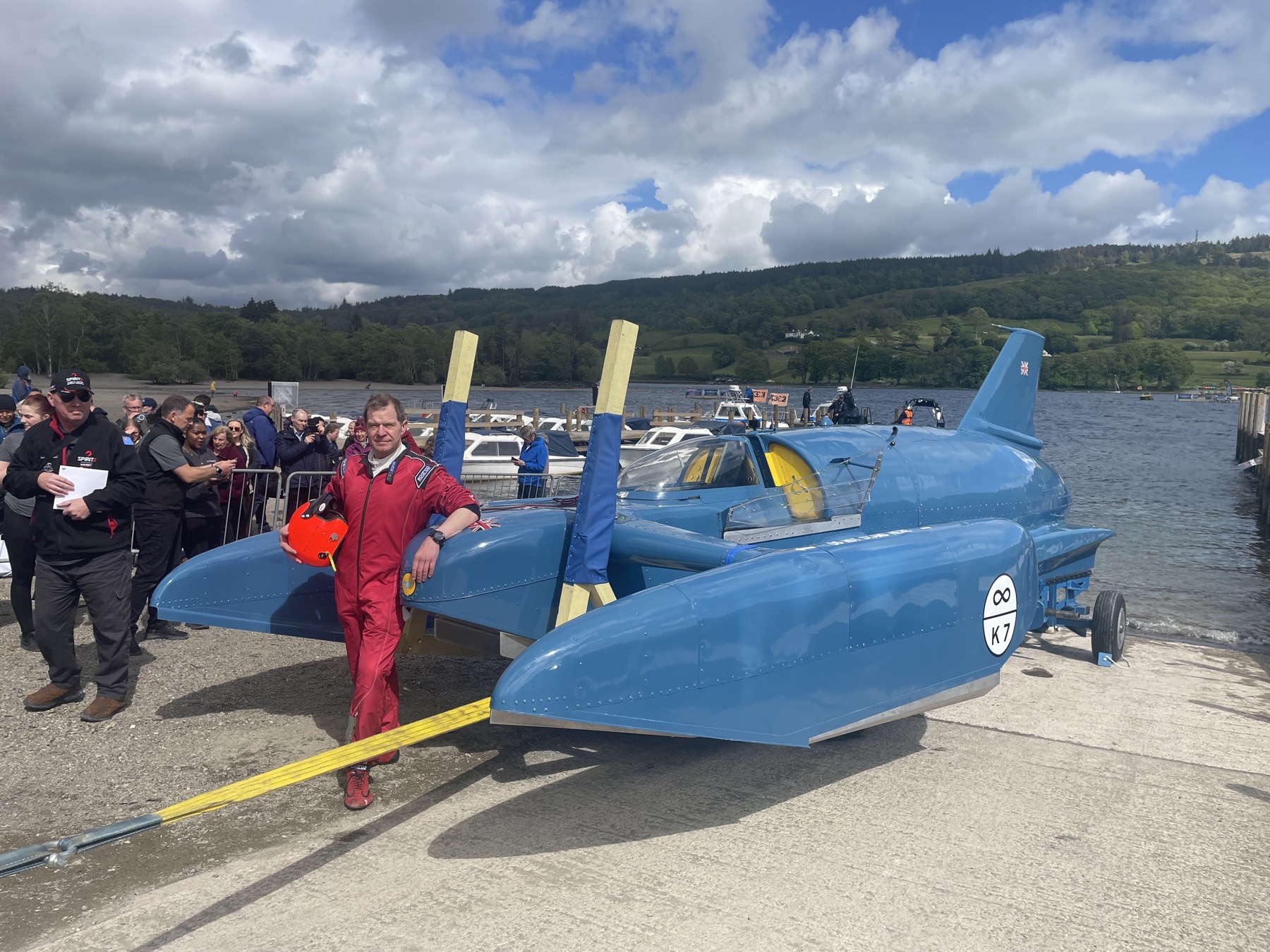
Frustratingly for DJ and I would imagine likewise for the public attending he was unable to drive the boat under power on that occasion. DJ’s professionalism as a military pilot including his detailed debrief onshore was as always exemplary and we cannot wait to see him in the cockpit of Longbow developing our jet hydroplane to do what she is built for.
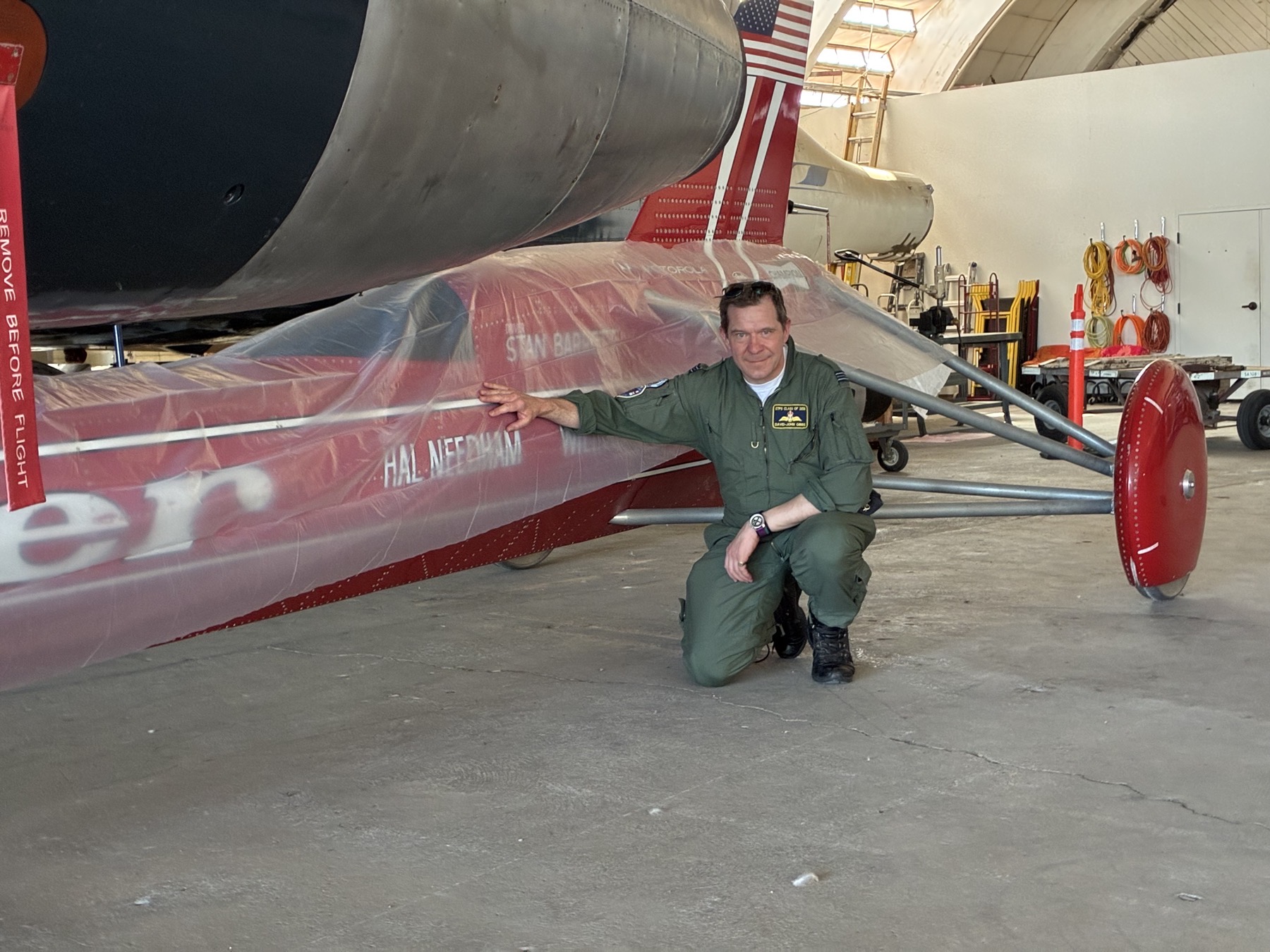
DJ has been busy with his RAF career travelling to the Edwards Air Force Base in California, USA as part of his test pilot training and whilst there he was able to have a good look over the Budweiser Rocket car as shown in the following photo. Stan Barrett the driver of the car was attending to give a talk about this amazing vehicle purportedly claimed as being the first car to break the sound barrier in a one way run at Edwards AFB back in 1979. The car being powered at the time by an LR87 liquid rocket engine from an intercontinental Titan missile, supplemented by an additional solid rocket booster from a Sidewinder missile to develop a combined total thrust of 30,400 lbs.
Since our last update aircraft electrician Nigel Fall has kindly been advising us with regards improving the design of our electrical start system for Longbow’s military aircraft derived twin jet engines. As part of that Nigel suggested we reach out to a company who manufacture an electrical start pack for jet engines. Having then somewhat disappointingly received no reply from our enquiry to such a manufacturing company within our own country, we then widened our search further afield to the USA. There we stumbled across a family owned company whose headquarters are based in Las Vegas, Nevada, called rather appropriately Start Pac.
Start Pac was founded in 1997 by aeronautical and mechanical engineer Jim Worth and his wife Judith, after Jim became stranded with his helicopter in the Arizona desert due to a flat battery. Following that incident Jim invented a unit to start his helicopter engine and as a result of that his wife being entrepreneurial, encouraged him to begin manufacturing it whereupon the business, no pun intended really took off. Today Start Pac has grown into a very successful business manufacturing over 70 different models of their engine starting unit for various sized aircraft, helicopters, locomotives, engines within the heavy construction sector and mining industries.
Whilst Jim still remains head of engineering at Start Pac, his stepdaughter Eve Storm, MBA, MA is now the Company Owner, President and CEO. From my perspective I must admit that given our previous experience of receiving no reply from our enquiry to a British company that we had reached out to, I had little optimism that we would receive any response from our similar outreach via email to Start Pac in the USA.
Well how wrong could I have been for within a few minutes of my email arriving at Start Pac, who should call me on the phone but Eve herself with her boundless energy and enthusiasm for our little venture; which took me somewhat by surprise given the thousands of miles between us. I then spoke on the phone with Eve’s stepfather Jim regarding the technical aspects of what we were seeking and again he was equally full of enthusiasm for Longbow and how they could assist with making the venture happen.
I was really struck by how the conversation changed from me being the one asking if they had a suitable product for our application to them both inspiring and encouraging us that with their assistance they could help get Longbow running and on the water doing what she was built for. Unbeknown to me at the time Start Pac had already provided one of their jet engine start units to the owners of a truck called Hot Streak II. This however is not your average truck since it is powered by twin afterburning / reheated pure thrust jet engines and runs very successfully at various drag racing venues within the USA; so obviously the Start Pac unit is an existing well proven start system for our twin jet engines on Longbow.
Jim had some queries regarding ensuring protection of the Start Pac unit from the electrical power each starter generator on the jet engine produces, once it changes to generator mode after successfully starting its respective engine. In this regard Nigel with his electrical aircraft experience was able to provide the technical answers to Jim’s questions and as a result Eve has not only sponsored us one of their start units complete with its associated transportation trolley but also she very kindly provided the corresponding aircraft furnished electrical connector and took care of all the shipping costs from the USA.

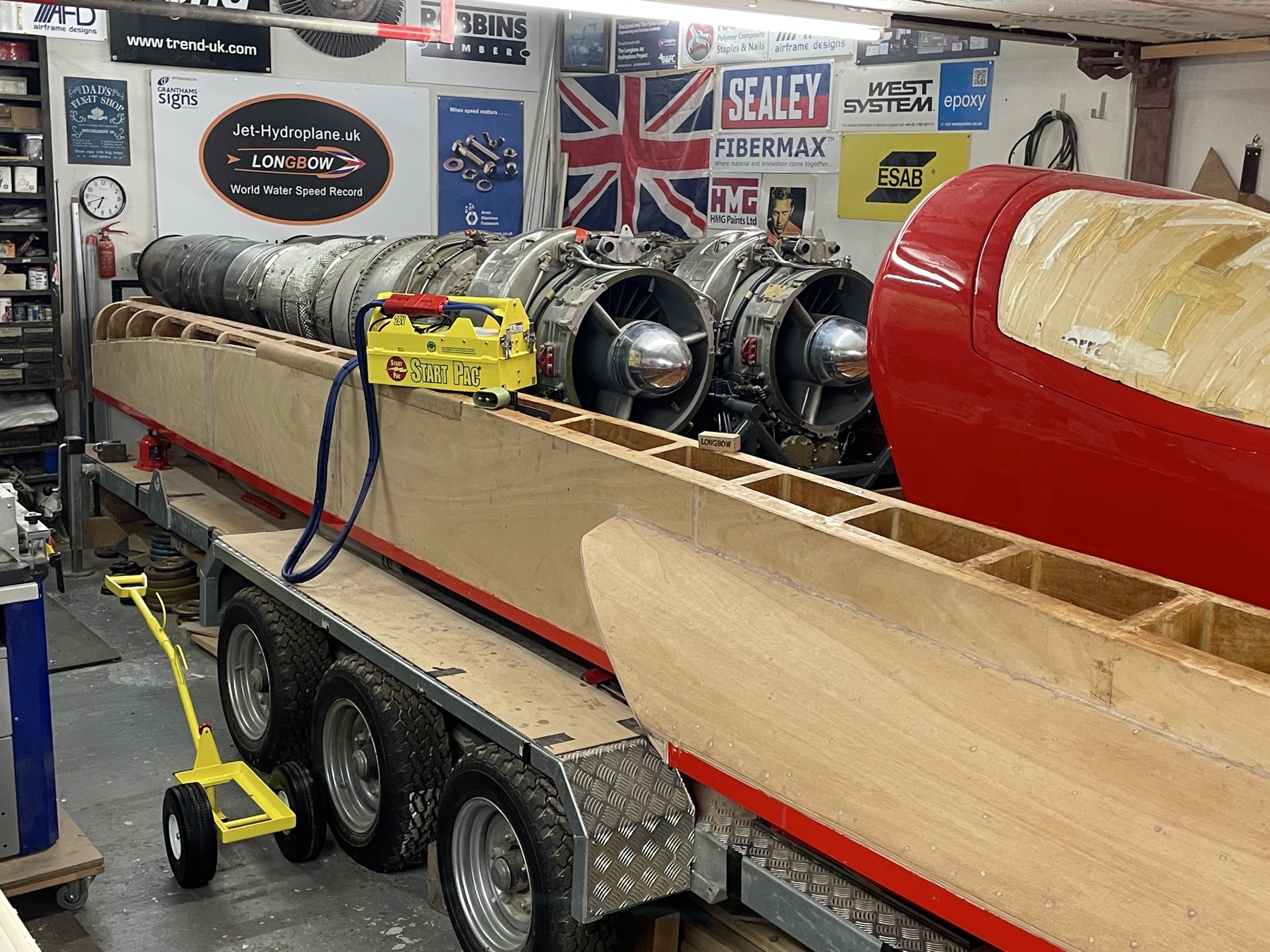
Their unit which Jim states should provide us with four good jet engine starts is based around an aircraft voltage 28v DC lightweight lithium battery with integral U.K. mains supply battery charger. One of the outstanding features of the Start Pac unit is the rapid speed at which it will start a gas turbine thereby reducing the engine temperature during that start sequence and consequentially helping maintain the service life of the turbine components.
In May of this year David Warby, his partner Lesa and some of his team had travelled from Australia to the U.K. and it was lovely to have them visit us in person for the first time, rather than the video calls, emails, etc we have grown accustomed to over the many years that we have corresponded. As you may be aware David is currently up to around 280mph with the ongoing development runs of his jet hydroplane Spirit of Australia II at Blowering Dam NSW, Australia. This being as he works towards making an attempt upon the Outright World Water Speed Record (WWSR) of 317mph set in 1978 by his late father Ken Warby MBE in his jet hydroplane Spirit of Australia.
If it was not for David’s enthusiasm for us to build our jet hydroplane Longbow then certainly we would not have embarked upon the venture, for as part of that encouragement it has been invaluable to have his thoughts, guidance and feedback from his own and indeed his late father’s experience passed down to David, of building, running and developing a jet hydroplane for a credible attempt at the Outright World Water Speed Record (WWSR).
Whilst through our friendship David had seen photos and videos of Longbow under construction it was for my part somewhat daunting to have him and his team meticulously go through our entire craft from bow to stern. Many of you will perhaps at some point in your lives have experienced that feeling of anxiety as someone who knows just what they are looking for goes through your project, as you stand back answering as best you might, their searching technical questions.
During that time as David and his team members inspected the boat, my silent thoughts were not surprisingly something along the lines of was Longbow’s build good enough to be a credible contender for the WWSR? The clock upon the workshop wall ticked by as David and his team’s very detailed inspection of the craft continued until after what seemed like an age David and his right hand man, the very experienced hydroplane racer Pete Jarrett gave their verdict.
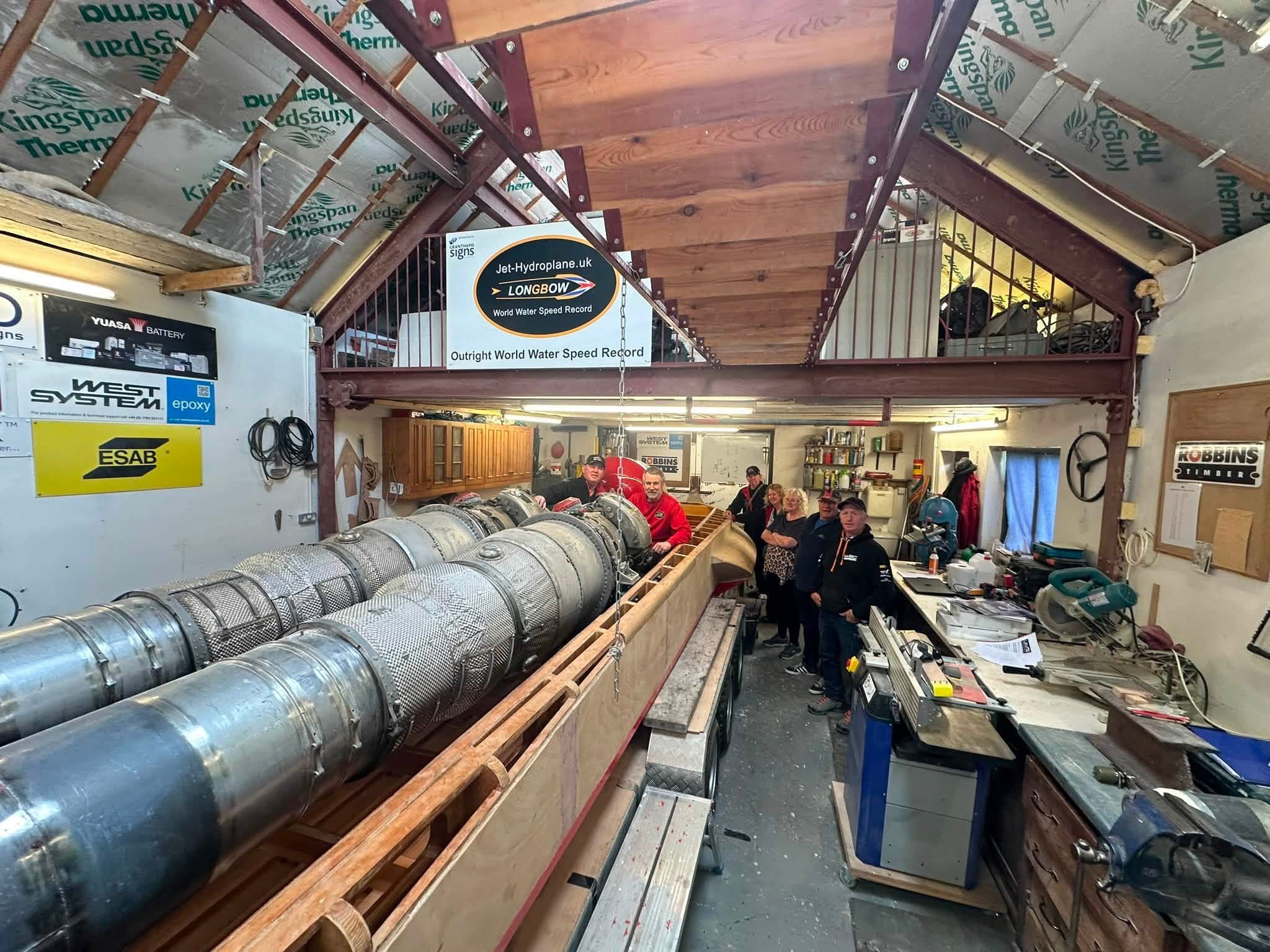
To my relief they gladly gave Longbow their thumbs up seal of approval saying she’s a credit to our team, a great build, a strong hull and very much a credible contender for the Record. Indeed so pleased were they with the boat that they have offered to assist us with development of the craft going forward. You may appreciate that for such an endorsement from these guys who I hold in such high regard, I could not have been more pleased at passing their very detailed tech inspection and offer of assistance for which that now certainly provides us with the confidence to progress with the build.
Following that meeting my good friend Charles Morris had asked me to invite our Australian friends to come and see a jet hydroplane built at his family owned engineering factor, Helical Technology, which is based on the Fylde coast, Lancashire. That craft which was completed in the latter part of 2011 is affectionately named Silverbird K777 and I personally know the boat rather well having worked upon this jet hydroplane for some time all those years ago at Charles’ request. The following photo shows David trying out the cockpit of the craft whilst chatting with Charles and it was readily apparent that everyone present tremendously enjoyed the visit, which not surprisingly included discussion upon the possibility of Silverbird K777 being further developed and run again in the not too distant future.
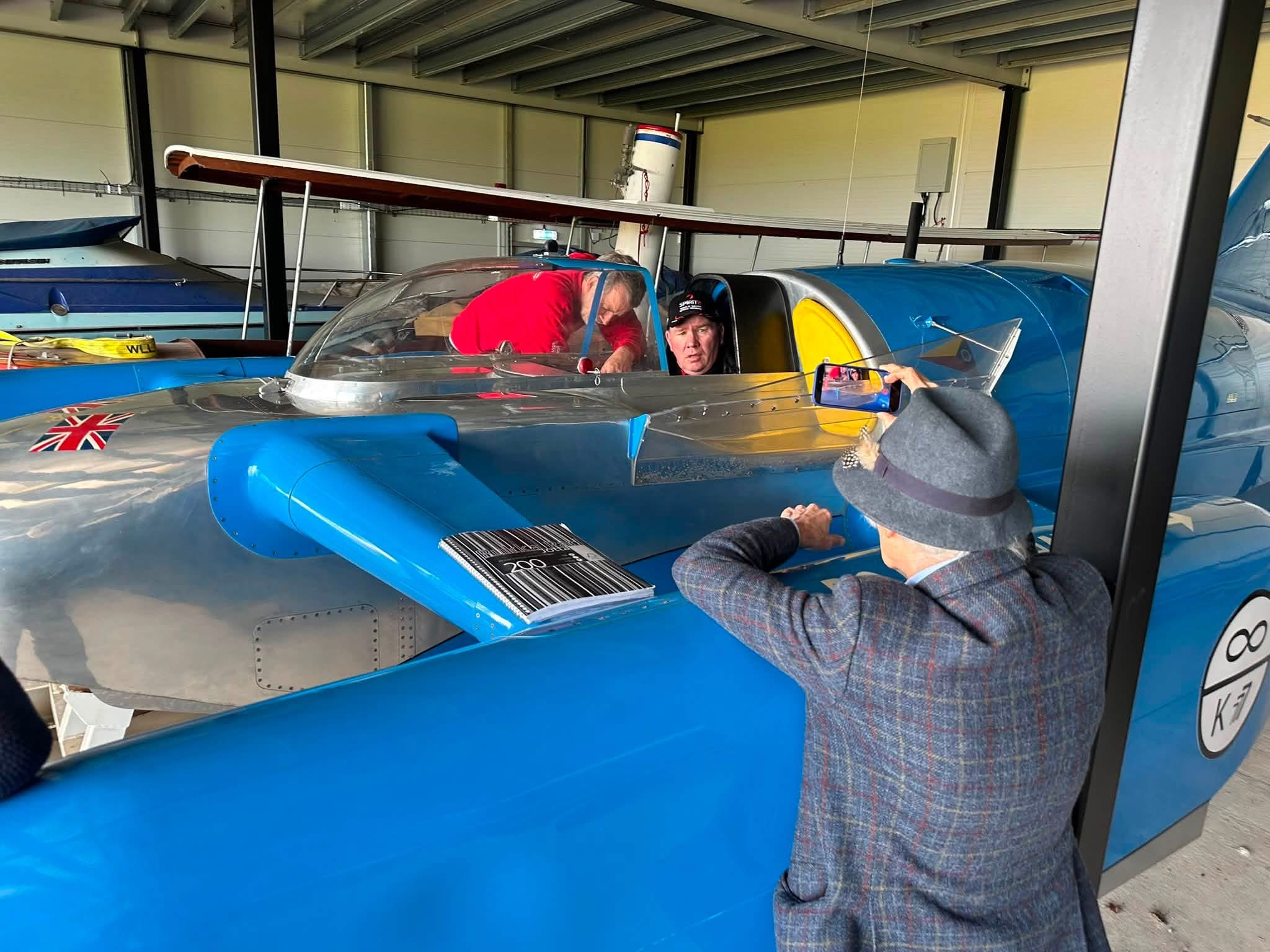
For clarification the Silverbird K777 was neither designed nor built as a contender for the Outright World Water Speed Record (WWSR) but rather to perform two primary functions. In the first instance to be a static exhibit within Helical Technology’s private Motive Power Museum and secondly as and when the Morris family so choose, for the craft to undertake occasional dynamic public displays under her own power out on the water as a sight and sound experience for the enjoyment of all.
That recent visit to Helical Technology in turn prompted me to dig out an old video that one of my sons, Robert (who was only aged 13 at the time) had put together of the Silverbird K777 being constructed and showing her first venture out onto the water. A link to this video is given later within the discussion herein. Watching the video again brought back a lot of happy memories of that project with self employed and exceptionally talented engineer Dave Beaty who was contracted by Helical Technology to be the primary fabricator of the boat.
For Dave to have completed this work pretty much on his own in around three years from somewhat basic design drawings that Charles’ son Ben had drafted out a good while before I assisted with the project, was by anyone’s reckoning a staggering highly skilled achievement. During that construction phase Dave told me that he was taught metal forming by one of the original workforce who had fabricated Bluebird K7 at Samlesbury Engineering, Lancashire, a company which was later absorbed into BAE Systems where Dave was employed for a number of years before setting up his own business, DBT Engineering in Preston.
I am aware that there has previously been some online discussion regarding the Silverbird K777 air intakes for her Orpheus jet engine and in that regard for clarification Dave Beaty formed these from measurements taken from the air intakes of Folland Gnat XM708 that Helical Technology own as part of their private Motive Power Museum, given that aircraft had used the same model of jet engine.
When I looked at the video of the boat, my son Robert as a young lad can be seen within the cockpit of the craft, my wife Gill helped out with installing foam buoyancy within the hull, one of my daughter’s Jenny and her friend Danielle are featured painting various bits of the boat launching cradle. My pals Steve and Fred are there helping with the build, paint spraying the boat itself then her launching trailer along with forming by hand the buck for its canopy and rigging the driver harness around Ben in the cockpit; a photo which mirrored one taken many years ago of Donald Campbell being strapped into Bluebird by his faithful mechanic Leo Villa.
Our gas turbine engineer friends who I brought in to assist with the project Paul Davidson is seen at night sat in the cockpit of the partially completed boat at Helical, with fellow gas turbine engineer Graham Pool stood next to him enjoying a chat after a successful engine test run. Both of these lovely gentlemen taught me so much about gas turbines as we undertook a deep strip engine rebuild of one of her gas turbines with subsequent engine testing and for me it is very poignant seeing those together in the video given sadly both of them have since passed away.
Chartered design engineer Ken Wheeler who was a Managing Director for Norris Brothers business (the company who designed Bluebird K7) undertook some design work checks on the spars and sponsons of Silverbird K777 with Ken being a dear friend and mentor to myself until his passing in 2018.
Whilst the craft was built as a jet hydroplane in its own right, visually it is in many respects outwardly similar in appearance to Bluebird K7. Indeed both jet hydroplanes incorporate the same Folland Gnat aircraft tailfin and they both use an Orpheus jet engine that originally powered the Gnat.
Only three days after the boat was completed she was undertaking her first trials under power at Coniston Records Week in 2011. During one of those tests out on the lake Silverbird K777 took on a considerable amount of water due to an aluminium fairing that closes the external bodywork between the rear spar and main hull partially opening from nothing more than a shortfall in the number of fixings to keep it in place.
The following photo shows the rear spar and main hull closure fairing under discussion from which I hope you will appreciate the high standard of metal forming fabrication that the very talented Dave Beaty put into building the craft.
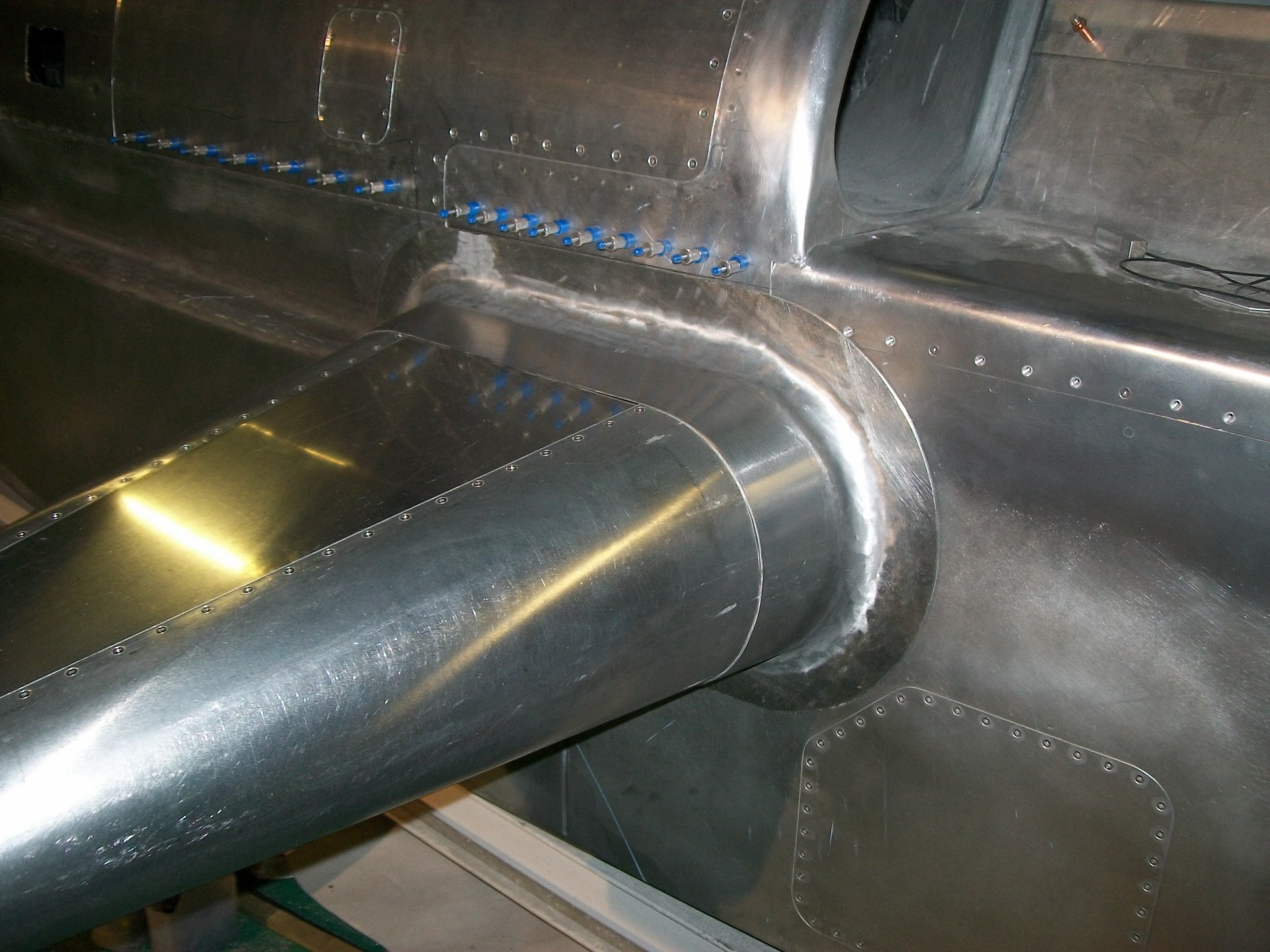
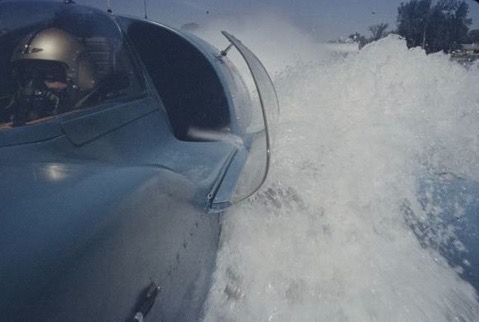
The shortfall in fixings to this closure fairing was merely an oversight in the rush to get the entirely new craft finished for Records Week and one may appreciate in the following photo of Donald Campbell driving Bluebird K7 the amount of turbulent water in this area that the panel was being exposed to whilst running in her displacement stage.
There was in the case of Silverbird K777 a tremendous amount of foam buoyancy that we had the foresight to have installed within both the main hull and sponsons which was sufficient to keep the boat on the surface of the lake despite the considerable amount of water taken on board from this fairing panel opening up.
Jim Noone as calm as a cucumber simply stepped out of the cockpit of the boat and into the rescue tender alongside and with the jet hydroplane looking somewhat sorry for herself she was towed back to Pier Cottage (where we were based for those trials) and once upon the slipway her onboard bilge pump readily drained the hull of all the water she had taken on board from the issue.
Of course the press and the social media trolls at the time made a great deal of the issue with headlines such as ‘You Blue It’ but for me I just felt sorry for Dave as it no doubt ruined the public praise he should have so rightly received for such talented metal forming fabrication of the boat. Hindsight is a wonderful thing and we all should have picked up on the fairing needing more fixings prior to it travelling at speed in the water but such is life, these things happen and that is what testing is for with an entirely new jet hydroplane.
Those who know the history of Bluebird K7 will recall that when the craft was first built she was taken to Ullswater in the Lake District during 1955 only to find her trim was completely wrong with the front of the boat underwater and hence under power that water readily flowing into her jet engine air intakes and completely shutting the engine down. To resolve this very serious design flaw where the boat would not work at all, required major structural alterations of the boat. So bearing this in mind then by comparison with the relatively minor issue we had occur during our first testing of Silverbird K777 out on the lake under power we had clearly got off somewhat lightly.
Nevertheless the upshot then was we had a jet hydroplane looking somewhat similar to Bluebird on the slipway in a tent at Pier Cottage (which was the same location that Bluebird had been based back in the 1960’s) and now she desperately needed our help to get her back running. I can remember saying to Charles at the time something along the lines of ‘right let’s show folk what we can do when we are up against it’ so in true Donald Campbell and his loyal team fashion we all rolled up our sleeves and got to work as we grafted on the boat right through the seasonally cold night.
As these works were being undertaken members of the team drove back to Helical’s factory to bring back parts, Fay at Pier Cottage kept us warm with a never ending supply of hot drinks, a heater was sourced to put into the saturated cockpit and even boat parts were put into the cottage kitchen oven to dry them out. As daylight broke the next morning the crowds returned and with the boat chained down to the slipway Charles climbed into the cockpit and pressed the jet engine starter button. To everyone’s relief Silverbird K777 roared back into life and Charles was then able to complete a very successful static run of her jet engine on the slipway.
This was then followed by Jim taking the boat out for further trials on the lake but being the last day of the event the weather was in typical Coniston fashion against us and we had to be content with the her tantalising rising up out of the water but she didn’t quite lift her skirt high enough to get onto the plane and fire down the lake.
As silly as it might sound I think for everyone there that worked through the night on the boat and clearly gave their best to achieve what we did 15 years ago, despite the cold harsh conditions and long hours, actually enjoyed themselves. It was just so atmospheric of Campbell struggling at the same location decades ago with the clock ticking to get our labour of love jet hydroplane back out on the water and running again for the last day of the event.
For the many folk involved they were just priceless memories and if I had my time again I wonder whether I would have unscrewed the fairing panel myself to let water back in just for the fun of once more working through the night on a jet hydroplane at Pier Cottage with Charles and his lovely family, along with our host Fay and everyone else who mucked in to get the boat up and running the very next day.
For anyone in doubt please let me assure you the Silverbird K777 jet hydroplane is with a little more development certainly capable of getting up on to her planing shoes and running across the lake at speeds intentionally limited by her owners to less than 150mph, so as to be a terrific sight and sound experience for everyone to enjoy.
This video of the Silverbird K777 back in 2011 was at the time posted online for a little while but in consideration of David Warby’s recent visit to see the craft and renewed interest in the possibility of her being publicly dynamically displayed, we thought it would be nice to again re-post online this video for a little while that this time around has a revised sound track and introduction courtesy of my good friend Howard Bryan of Suma-design:
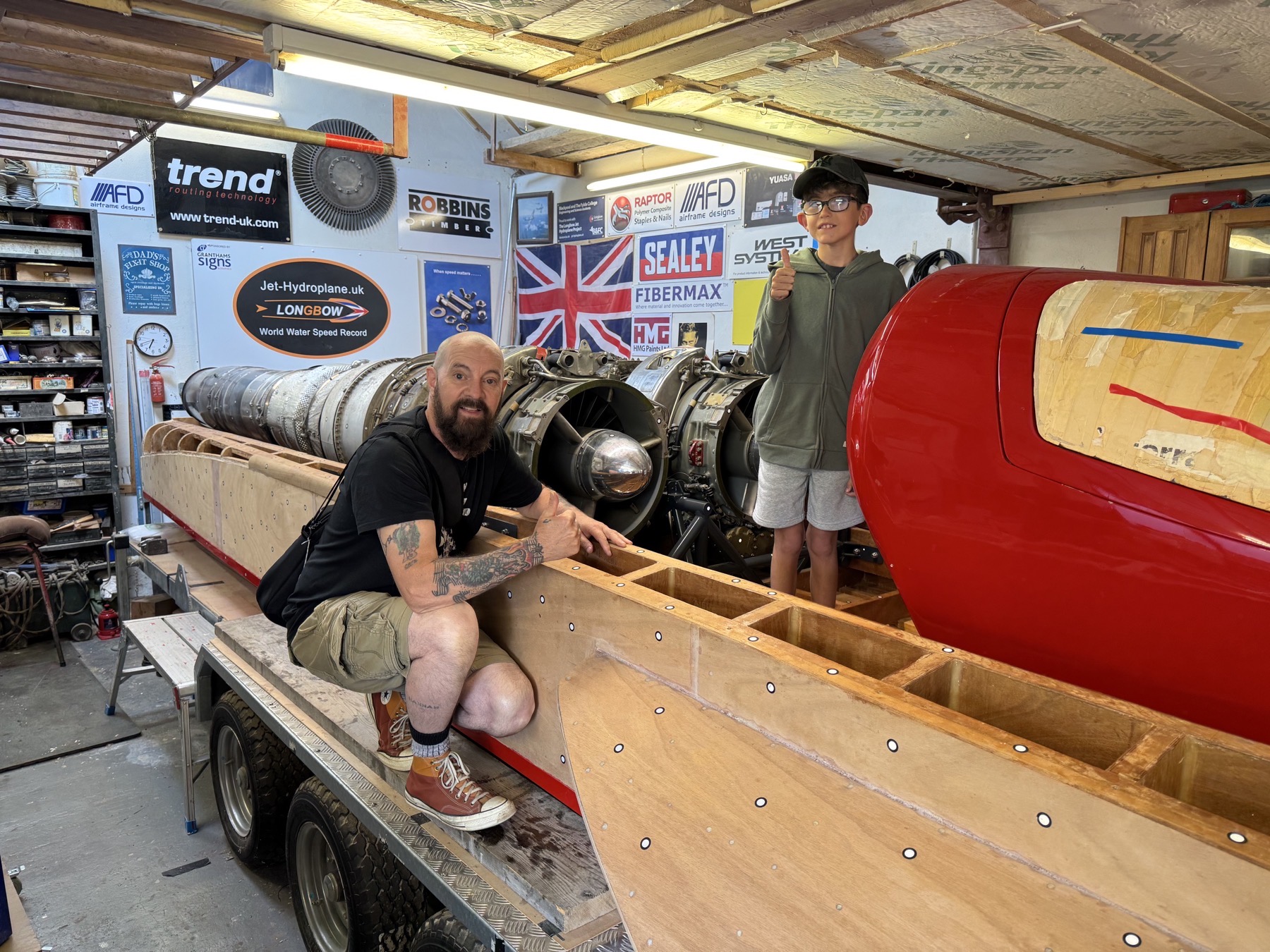
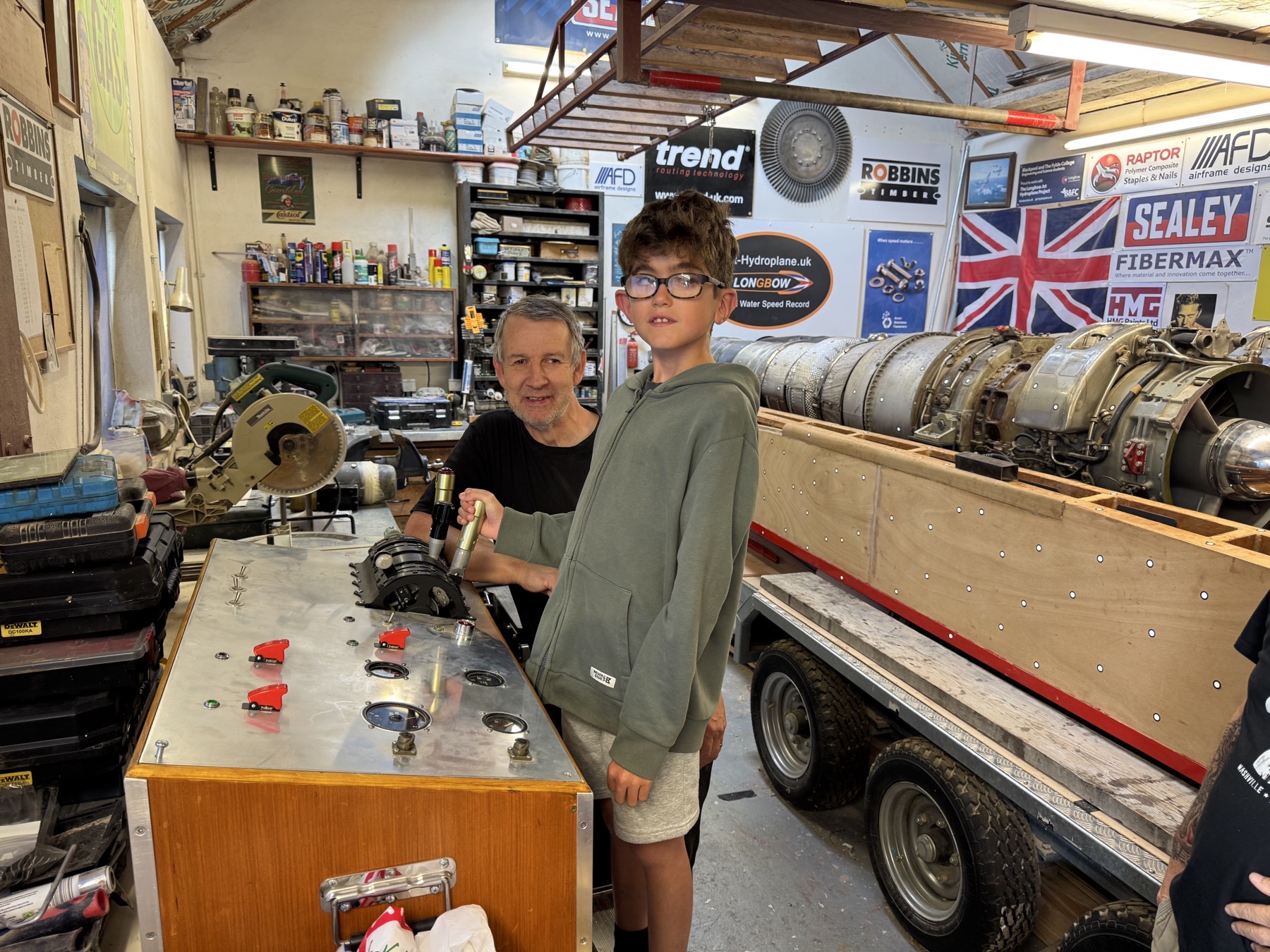
Back with Longbow and for us what our humble little project is all about, we were delighted to have a visit from a great young man by the name of Dexter Elliott who had travelled hundreds of miles with his grandfather Kev Rees to come and have a look at our boat, given Dex was so very excited to see unusually a WWSR contender with not just one but two jet engines.
At this visit it became readily apparent that Dex is passionate about physics, engineering, the sound barrier and most of all jet hydroplanes such that he had pleaded with his grandfather Kev to make the long journey to come and see this jet hydroplane he had clearly read so much about. During this visit Dex told us of his plans to design a craft to be the fastest boat in the world and it was fascinating listening to his well thought out suggestions of how we could develop Longbow including how to quickly slow her down after exiting the measured kilometre timing trap.
All of this reminded me somewhat of when I was his age and would do drawings of the development stages of Bluebird K7 in order to help me understand how the craft was improved by her engineers to achieve each of her successive water speed records. I fondly recall my aspirations way back then of how one day I might build a contender for the fastest boat in the world whilst some of the adults in my life at the time told me not to be silly and forget such whimsical ideas.
Well Dex here I am with our team building our WWSR contender for real and we hope that inspires you a little to go on in later life and build your own jet hydroplane too. It was wonderful to have the opportunity to show you and your grandfather Kev around the boat, answering your questions about Longbow and how she is designed to work. Everyone here looks forward to your future visits especially when Longbow’s cockpit is in place and you can climb aboard to sit in the driving seat. We hope you enjoy the following photos of your visit to see us Dex with your grandfather where you may recall telling us all about your plans to design and build the fastest boat in the world.
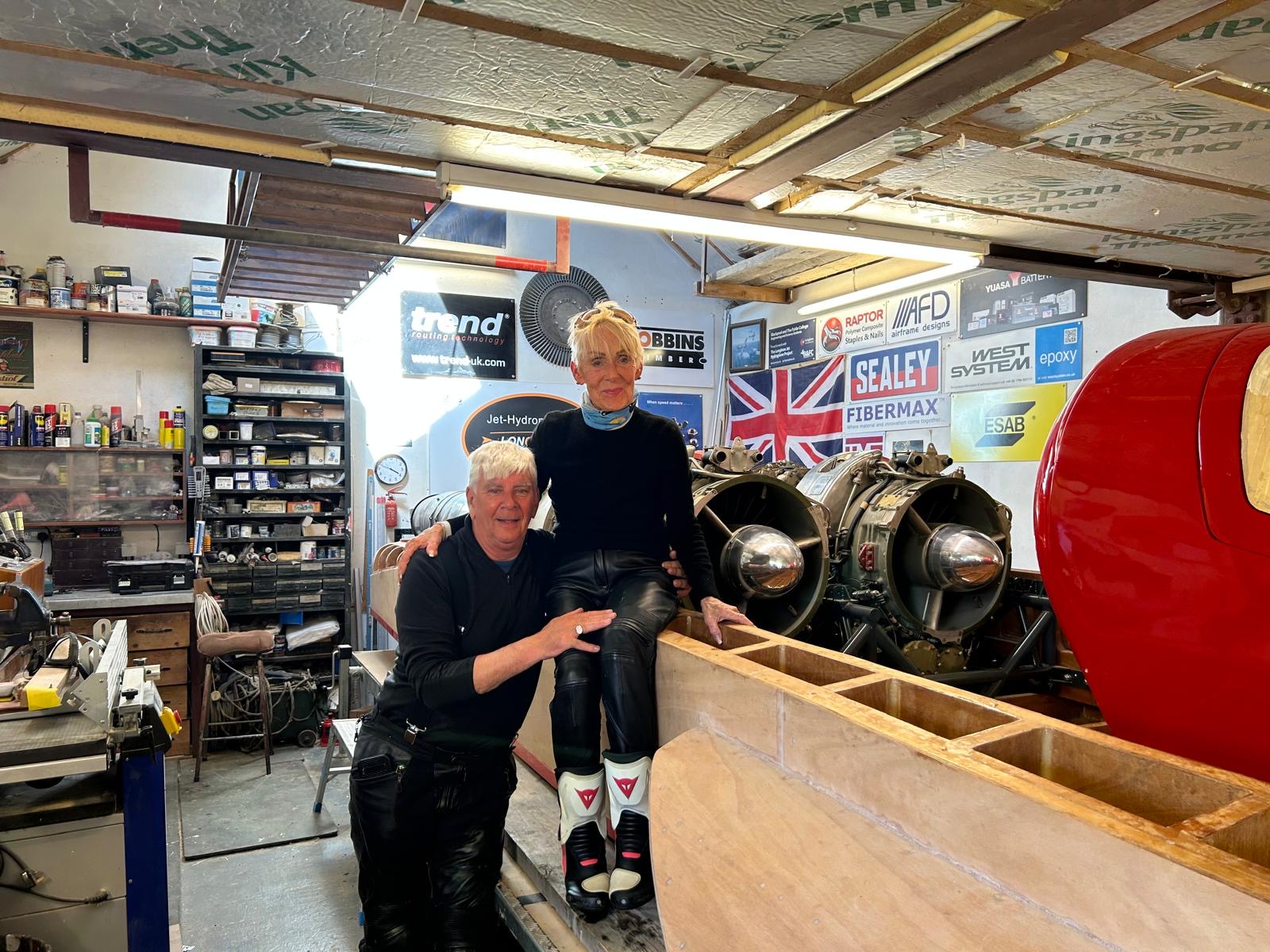
Another very special visitor to Longbow since our last diary update was Gina Campbell QSO, daughter of the late Donald Campbell CBE who piloted Bluebird K7 to obtain several Outright World Water Speed Records. Gina herself was a previous holder of the Women’s Outright World Water Speed Record and her partner Brian Eastham who accompanied Gina on her visit has himself twice held the 1.3 litre class offshore powerboating world titles in addition to competing in the Isle of Man Classic TT. The following photo shows Gina and Brian with Longbow having travelled to see us on one of Brian’s motorbikes. Good friends, great company and always plenty of interesting banter as we put the world to rights over a brew.
To have had our good friend David Warby, with his late father being the current holder of the record for the fastest boat in the world come and visit Longbow, then later Gina daughter of Donald Campbell the most prolific holder of the same record likewise sat on Longbow followed by Dex and his grandfather Kev travelling hundreds of miles to come and see Longbow has certainly upon reflection been a series of pinch myself how cool are these occurrences. Thinking back to when I was a kid sketching those drawings of Bluebird I could never have imagined such visits happening but that is all part of the enjoyment of doing this project, it is not just about the destination but the lovely people you meet along the journey, so happy days and great times had by all.
The number of folk kindly helping us with the project has grown a little since our last update not only with Nigel with the electrics as previously mentioned but also the following guys who are great to be around and bring so much to the table.
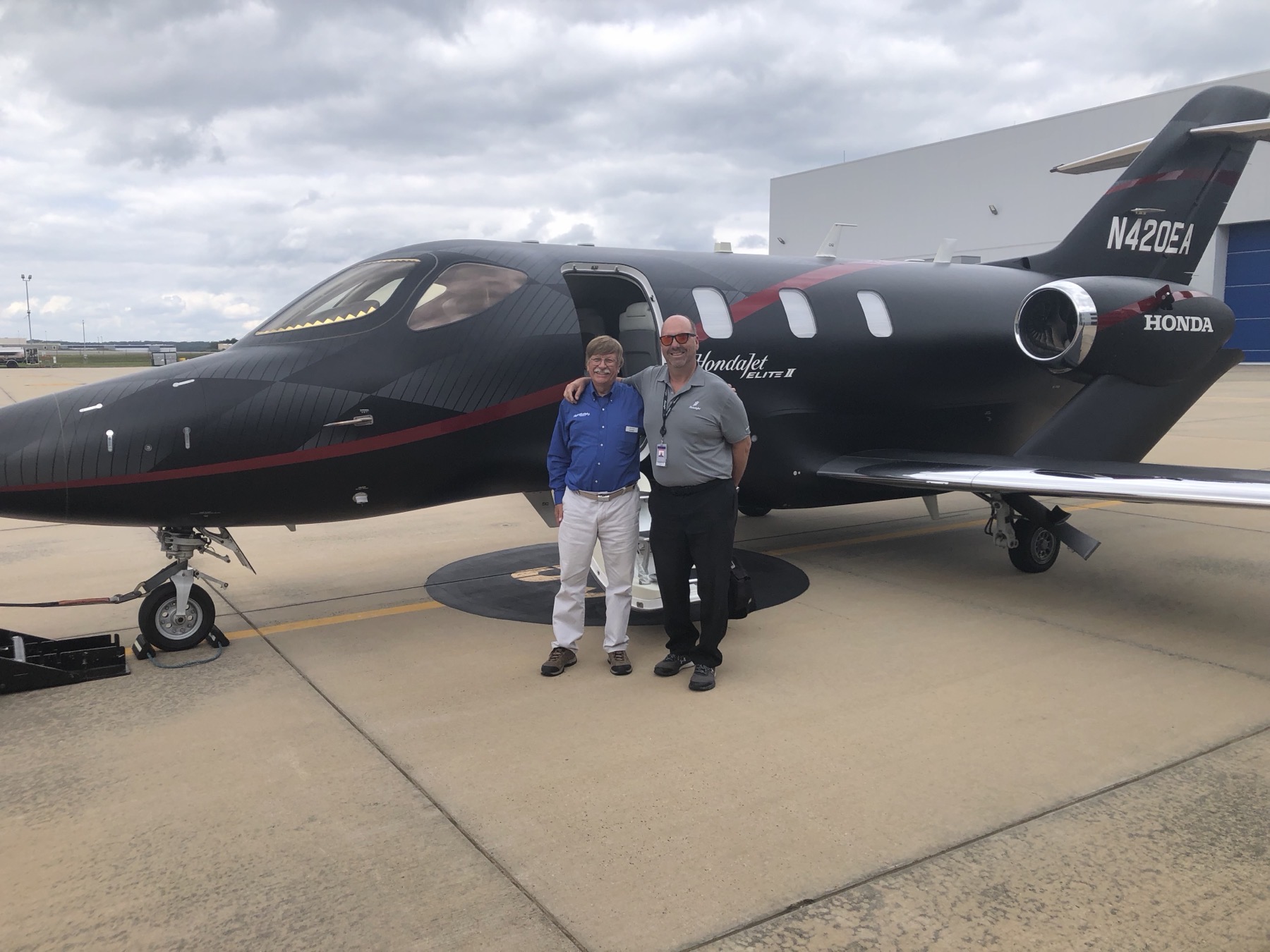
Adrian Lewis who has a lovely Cobra car amongst his classic vehicle collection, his friend Paul Murro who owns / competes in rallysport with his cracking Millington powered Mk2 Escort, local motor engineer Phil Craggs along with former aircraft pilot with a passion for boats in his spare time, David Heap who has piloted and instructed upon many types of aircraft from Boeing 737’s to development of the latest Honda HA-420 business jet as shown below.
David’s knowledge of airframes and jet engines, along with a safety first approach to prototype jet powered vehicle development is a tremendous asset to our venture that obviously has much in common with our RAF pilot DJ the driver for Longbow.
As many of you will be aware the annual international Coniston Records Week for this year commenced on Monday 2nd November where entrants to the event are permitted to drive their boats in excess of the general 10mph speed limit upon the lake. The competitors for the class of record they are attempting accelerate their boats up to and then pass through a measured kilometre timing trap, followed by decelerating to turn around and run in the opposite direction within the hour. This being in order to obtain an average speed (the record speed) of those two runs through the kilo timing trap in both directions, all as set out within the Union Internationale Motonautique (UIM) rules of the governing body that sanction the event. Only boats which comply with current UIM rules are allowed to enter the Coniston Records Week event.
The UIM have historically since 1928 been the governing body for the Outright World Water Speed Record (WWSR) when at that time the Record was just 92mph. The trophy for the WWSR is owned by the Royal Motor Boat Yacht Club (RMBYC) in the U.K. and is awarded to those achieving a new WWSR (fastest boat in the world) at an average speed undertaken in the manner previously described and specifically only under UIM governance in compliance with their rules.
When I attended Coniston Records Week this year I had a very productive meeting regarding the design of Longbow’s cockpit with Bob Wartinger from the USA, who for many years up until recently was the President of the Safety Medical Commission of the UIM. I have known Bob since I commenced our project and on his return to the U.K. this year Bob became an honorary member of the K7 Club awarded to him by Jim Noone who as previously mentioned has driven Silverbird K777.
This recent chat with Bob regarding Longbow’s cockpit leads me on to the discussion herein of where we are up to with this element of the boat at present, for which I appreciate that for those already following our venture some of these matters you may already be aware of. However in consideration of the several months since we previously issued a project update and also for the benefit of those new to the venture, it is perhaps prudent to encompass herein some degree of background upon the matter of Longbow’s cockpit that has for so long been holding the rest of the boat construction up until it is completed.
So for those of you who are not aware competitors wishing to attempt UIM sanctioned speed records at or in excess of 150mph, UIM rule 601.01 applies which was introduced during 2013. This specific rule requiring engineering analysis to be presented to the UIM which demonstrates that for a boat attempting the record at or over 150mph the integrity of the cockpit in the event of an accident / crash can be maintained for the speed record being attempted.
It is of note that the primary international governing body for land speed record attempts by vehicles, (the FIA) have no equivalent rule requiring engineering analysis to show the integrity of the cockpit will remain intact during an accident / crash for the speeds being attempted. This perhaps not being surprising given the land speed record is currently 763mph.
Bob himself had achieved a UIM outboard engine class record of 176mph back in 1989 driving a boat that would not now comply with this UIM rule 601.01. Likewise Jim Noone achieved a class record of 154mph during 2003 in a boat that would not now be compliant with UIM rule 601.01.
Bluebird K7 is unable to run at Coniston Records Week as it is not compliant with a number of current UIM rules including but not limited to rule 601.01. You will note that online discussions for demonstration runs of this craft typically mention a speed limit set by the owners of not exceeding 150mph which coincidentally mirrors the threshold for UIM rule 601.01 being applicable.
The H1 Unlimited hydroplanes in the USA race several boats together around a circuit at speeds anywhere up to 200mph but they do so under their own set of rules outside of the UIM despite being affiliated to it. As these boats are racing and hence not undertaking speed records, in addition to them running under their own set of rules outside of the UIM, they do not submit engineering analysis under rule 601.01 to the UIM.
The Unlimited hydroplane Peters & May U-11 came all the way from the USA to Coniston Records Week in 2012 (the year prior to UIM rule 601.01 being brought in) and set a class record of 175mph in addition to being a fantastic sight and sound experience that drew considerable crowds and television coverage to the event at the time. However the craft has since been unable to return to attempt to better that record because the boat does not comply with UIM rule 601.01.
The UIM F1 powerboats circuit race at speeds of up to 155mph but it appears that they do not enter engineering analysis to the UIM to show the integrity of their cockpits will remain intact for a crash at these speeds as under UIM rule 601.01 this only relates to speed record attempts over 150mph and not circuit racing.
Accordingly if a UIM F1 powerboat came to Coniston Records Week to run a kilo record at or above 150mph this would not presumably be permitted without the engineering analysis being submitted under UIM rule 601.01.
In the case of both H1 Unlimited hydroplanes and UIM F1 powerboats it is not unreasonable to wonder which is more dangerous, one person in one boat undertaking a speed record attempt on their own in excess of 150mph, compared with several of the same boats circuit racing side by side with other drivers in their boats at the same speed in excess of 150mph?
If Charles and his family wished at some point in the future to attend Coniston Records Week with their Silverbird K777 then likewise it would be limited to speeds under 150mph unless it could be shown by engineering analysis submitted to the UIM that its existing cockpit is able to remain intact for a crash at speeds in excess of 150mph in compliance with UIM rule 601.01.
The current Outright World Water Speed Record (WWSR) boat Spirit of Australia where it broke the record in 1978 is not UIM rule 601.01 compliant and neither is its successor Spirit of Australia II with the latter designed, built and run by the current record holder’s son David Warby. Therefore David’s SOA2 boat would not be permitted to exceed 150mph at Coniston Records Week despite David already having run the boat outside of the UIM governance in Australia at speeds up to 280mph.
Within the USA an annual event at the Lake of the Ozarks, in Missouri, is where boats compete to run in a one way pass (i.e. not in both directions) through a timing trap measured at three quarters of a mile. The highest speeds achieved at the event are just over 240mph. However this is done completely outside of the UIM governance.
The sport of drag boat racing is generally specific to the USA and their boats run at speeds up to just short of 280mph which is done under their own set of rules completely outside of the UIM governance.
Since UIM rule 601.01 came into force in 2013 the fastest speed of a boat participating at the annual Coniston Records Week event appears from an online search to be 133mph which occurred at the event in 2022. For the 2026 event which has been completed earlier this month (bearing in mind this is an international event), it appeared that around 18 boats competed, of which I only saw one with an enclosed cockpit and the highest speed achieved subject to ratification was less than 101mph.
In the past 13 years since the UIM introduced rule 601.01 all of the speed records at Coniston Records Week have been well under the 150mph threshold for this rule to be applied.
It is not unreasonable to suggest that if one asked members of the public as to which governing body sanctions car and boat speed record attempts they would typically say Guinness World Records, since they are the global reference authority that tracks, verifies and catalogues world records of human achievements and the natural world. The last time I looked Guinness World Records appear to have around 70,000 different records upon their books.
To give a comparison of land based motorsport with that of powerboating you may find the following figures from an internet search of interest:
For land based vehicles the FIA international governing body has around 80 million members over 245 national clubs in 149 countries.
In comparison the UIM for powerboating has only a few thousand members over 64 Federations in 60 countries.
This huge difference in numbers is perhaps not really surprising when one considers how many people drive cars and hence the broad appeal of various types of land based motorsport, compared to how relatively few people own a powerboat and of those how few actually undertake powerboat racing. Of those competing in powerboat racing only a portion are worldwide within UIM governance with several other governing bodies being in place, for example those pertaining to drag boat racing, H1 Unlimited, etc, running under their own set of rules.
Some people have publicly stated that they feel UIM rule 601.01 was only brought in to prevent teams attempting the WWSR under UIM governance. This cynical view may have been somewhat perpetuated by the fact that the UIM themselves have not published a specification for cockpit construction that would satisfy their own rule 601.01 especially when applied to attempting to exceed the current WWSR of 317mph.
At the heart of all this is a central debate over the value of extreme sports, or indeed the ethics of risk in sport. Many will argue that the inherent danger of activities like attempting the WWSR, competing at the Isle of Man TT, mountaineering, etc is not a flaw but actually the core element that gives these extreme sports meaning.
That is to say should an adult person have the freedom to test their own limits within a sporting activity if that does not adversely impact upon anyone else, even if some people in society view that as reckless? Those participating in extreme sports are typically not thrill seekers looking for random danger but more they are individuals who are highly disciplined, mastering their skills to achieve their goals while minimising the overwhelming risk to a level that they personally deem to be acceptable.
If one took no chances, one would not fly at all. Safety lies in the judgment of the chances one takes.
— Charles Lindbergh, journal entry 26 August 1938
One may take the view that the role of the respective governing body for each extreme sport that one may care to undertake, should be one of risk mitigation, rather than bringing in rules that to all intents ban the activity. This being especially so where there is no harm to others from undertaking that high risk extreme sport and in particular where it is undertaken so infrequently, by so very few people who are themselves brave enough to take the decision to be a participant rather than a spectator of that sport.
To put that into perspective over the last 36 years since 1990 right through until 2026 there were so many people worldwide killed in powerboat racing classes that I lost count of trying to collate the numbers, be they in small open powerboats right up to very large enclosed cockpit offshore boats and irrespective of whether they were competing within or outside of UIM governance.
For the Isle of Man TT races over the same period of the last 36 years there have been 118 fatalities of riders competing at the event.
Yet governing bodies of both powerboats racing against each other and motorbikes racing at the Isle of Man TT permit that racing to continue on the basis that participants know that these sports are inherently dangerous and are undertaken at entirely the participants own risk.
In stark comparison there have been absolutely no fatalities whatsoever attempting the WWSR in that same 36 year period from 1990 up to 2026. Indeed in the last 10 years there has only been one credible person with a jet hydroplane actually on the water attempting the WWSR, namely David Warby with him running outside of the UIM because his boat is not compliant with UIM rule 601.01 brought in during 2013.
If David is successful at gaining the title of the fastest boat in the world albeit outside of the UIM governance and that being achieved on the same course his father achieved that same title, which in the case of the latter was UIM sanctioned back in 1978; one might ask where does that leave the RMBYC with their trophy for the WWSR of the fastest boat in the world but for which that is only awarded if running under UIM rules / governance?
The salt perhaps being rubbed further into the wounds if Guinness puts David’s WWSR as the fastest boat in the world in their books, the same as his father’s was and his cockpit is somewhat stronger than that used by his father to gain the UIM certified record back in 1978.
Putting age to one side is it unreasonable to query why was it permissible for the UIM to allow both Bob Wartinger and Jim Noone to obtain their respective UIM water speed records prior to UIM rule 601.01 being brought in but the same drivers in the same boats, would not now be allowed by the same UIM to attempt the same record today under their governance, because those boats would now fail the cockpit engineering analysis as required by UIM Rule 601.01.
When it is only the same person alone on the same course in the same boat is it right for the governing body to step in and say you cannot attempt the same record / do the same activity under our same governance, not because you might hurt yourself but solely because your cockpit that you alone are sat in is no longer deemed strong enough to remain intact for a crash at the speeds being attempted.
In relation to the WWSR there is existing technology to run a boat autonomously (i.e. without a driver) which in effect would be a 1:1 full sized remote control boat. However imagine hypothetically a situation where that craft was run autonomously on a daily basis for several months such that people simply became used to it week after week zooming back and forth up and down a lake at WWSR speeds.
What if after all that time a person then chose to climb into the cockpit of the craft and sat there as the boat completed yet another run there and back to claim the WWSR record. Whilst those who don’t want us to put ourselves at risk will argue that is clearly a safety first approach, would that scenario really be in the spirit of what people testing themselves at attempting the WWSR and speed record breaking in general has now come to?
It is not unreasonable to suggest that when water speed record attempts sanctioned by the UIM are made including their many lower speed classes, then they are very much a fringe element of the UIM’s business, which is understandably focused primarily upon several boats racing around a course in close proximity to each other.
Consequentially it is not surprising to see within the current UIM rules why they have been amended time and again over the years to improve safety of drivers within boats racing against each other side by side. One may take the view that these rule changes under such circumstances become somewhat more justified since there is a degree of liability for injury or worse when drivers racing their boats together on a circuit are at risk of crashing into each other.
Hence the current UIM rules referencing boats not being allowed to have brakes (i.e. water immersed or parachutes) unlike when Bluebird had a water immersed brake fitted back in the 1960’s which was allowed by the UIM at that time. Drivers within UIM enclosed cockpits must now have a physical (i.e. not camera / monitor) 180 degree field of view and UIM rules require enclosed cockpits to be fitted with mirrors, which are obviously necessary to see and thereby try and avoid coming into contact with the other boats on the course a driver is racing against.
A trawl through the UIM boat racing categories reveals the typical speeds for each class during racing to be in the order of F1 powerboats around 155mph, F2 powerboats around 130mph, Class 1 offshore 140mph, X Cat 120mph, electric powerboats less than 100mph.
It appears that all boats currently racing at UIM sanctioned events have their enclosed driver cockpits as a permanent fixture within their boat hulls as did all previous UIM sanctioned WWSR contenders that we sampled.
Having considered this and looked at a number of historic crashes from previous WWSR attempts, particularly where the speed of the boat was in excess of 200mph, it becomes readily apparent that irrespective of the material the boat hull is constructed from, an accident at these very high speeds breaks apart that hull. Consequentially where the driver cockpit is a permanent fixture within the boat hull, this inherently means that following a crash at WWSR speeds there is a total reliance upon what is left of that broken apart hull on the lake surface, actually including an intact cockpit with the driver still alive and still inside that cockpit.
Even if that were the case that cockpit attached to a section of hull wreckage may well be in the process of sinking prior to rescue personnel arriving on scene and hence there is an inherent risk of rescue not being quick enough to extract the driver before that wreckage with driver strapped to it disappeared to the bottom of the lake. Once that happens and given the depth of a suitable lake upon which to make an attempt at the WWSR, then rescue might as well go to the pub and come back the next day, because they know full well it is going to be nothing more than a body recovery.
Now let us consider the following situation. Hypothetically say one might have a cockpit that was shown by engineering analysis submitted to the UM through rule 601.01 that its integrity would remain intact for a crash at the speeds being attempted, so for our example for a class record between the range where that rule commences to be applied, (i.e. above 150mph) yet below 200mph.
So what if the boat crashes during that record attempt and you go thank goodness the cockpit is UIM rule 601.01 compliant and it remained intact but wait a moment, oh dear the boat broke apart in the crash and although the cockpit remained intact as required by rule 601.01, it being a permanent attachment to the boat hull (as current UIM boat cockpits are), it is now only attached to part of that hull wreckage. Consequently without enough floatation left, it then sank to the bottom of the lake drowning an unconscious driver with it in the process before rescue arrived on scene. The fact that the cockpit in that example complied with UIM rule 601.01 was clearly of no consequence as to the fatal outcome in that the driver still drowned.
Turning our attention to the sport of drag boat racing which as stated previously is specific to the USA; they run under their own set of rules completely outside of the UIM governance. The upper classes of these boats produce in excess of an incredible 11,000 horsepower from their 8 litres / 500 cubic inch capacity V8 engines. These boats accelerate from a standstill reaching speeds just short of 280mph whilst travelling in a straight line over a timed course of 1,000 feet. During a run their drivers are subjected to around 4.5G in acceleration, which for comparison a driver sat in a Formula 1 car accelerating from the start line typically experiencing less than 2G.
When we refer to G (gravity) we mean a person on earth sitting stationary or travelling straight and level at a constant speed experiences 1G, that is to say their normal body weight, so for example let’s say a person weighing 180 pounds. However if whilst travelling at speed they make a tight turn or accelerate / decelerate at a force of 2G then that person feels like they weigh twice as much (i.e. 2×180 = 360 pounds). A fighter pilot with assistance from a specially designed inflatable suit they wear is trained to cope momentarily with forces of up to 9G.
Back with the drag boats the higher speed classes have a self contained safety cell capsule which in the event of an accident / crash are specifically designed to separate from the hull of the boat and then that capsule with driver inside remain floating upon the lake surface, whilst typically given the very high speeds the rest of the boat breaks apart and is destroyed sinking to the bottom of the lake.
The remaining floating safety cell capsule complete with driver inside is then designed to be crane lifted by the rescue crew from the lake surface onto a support boat which once onboard allows the rescue crew to extract the driver in a far more orderly manner than trying to do so in the water. Sometimes depending upon the nature of the incident the rescue crew on the tender with recovered capsule on board will take the capsule containing the driver back to the shore for driver extraction to be completed there.
These drag boat driver safety cell capsules have a high tensile steel tubular cage within them surrounded by an outer composite shell including cut down windshield section from an F16 military jet aircraft or equivalent. The windshields incorporate polycarbonate which is a material capable of absorbing tremendous impact loads vastly in excess of that which acrylic of the same thickness is able to endure (see this website July 2025 update for further explanation).
The driver inside the drag boat safety cell capsule breathes from a mask strapped to their face connected to a pressurised diving cylinder that is rigidly fixed between their legs to the steel cage of the capsule floor. Part way along the airline from mask to cylinder is a T-piece connector in order to allow if necessary support divers to connect into and thereby provide additional air supply for the driver. The harness restraining the driver in their seat is wrapped around the high tensile steel cage for reasons discussed later within this update.
Drag boat driver safety cell capsules are credited to have been pioneered by American James Brendel who was literally born into an existing high speed boat building business called Hondo Boats founded in the 1950’s by Irv and Peggy Brendel who prior to that had successfully built and raced hot rod cars. The following photo shows James as a young man during his early drag boat racing career.
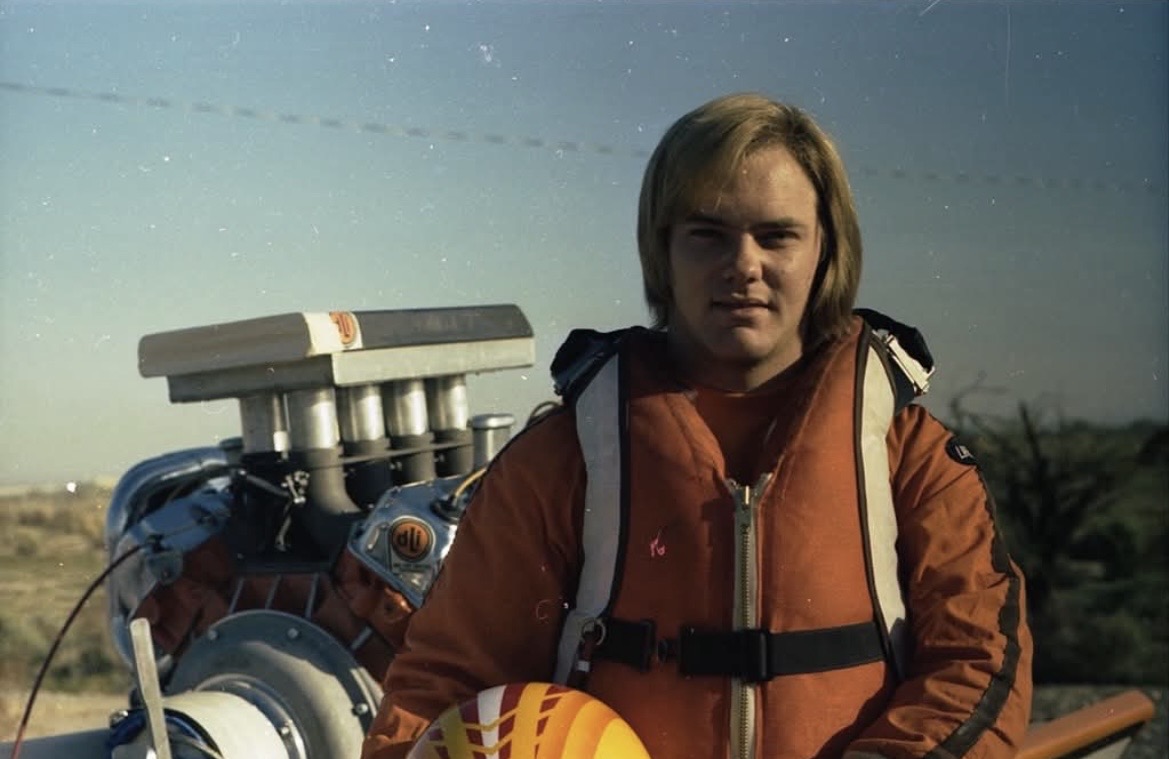
James grew up witnessing drag boat racers in open cockpits getting killed on a regular basis and determined there must be a way to help keep the drivers alive in the event of an accident / crash that would be superior to them literally strapping a parachute to their own backs in an open cockpit.
Over the years the drag boat driver safety cell capsules were developed and refined into those one sees in the sport today, with not surprisingly a number of different manufacturers now producing them each to their own variation of design. However these driver capsules all follow the same basic principles of a high tensile tubular steel cage within an outer composite shell, that in the event of a high speed accident are ejected from the hull to remain floating upon the lake surface with driver inside. Then to be crane lifted onto rescue tender. A James Brendel driver safety cell capsule has even been put into a top fuel dragster car which from a standstill reaches in excess of 330mph in 3.6 seconds over a course of 1,000 feet.
To illustrate how these driver safety cell capsules have saved many lives, one notable example took place in the 1990’s where an alcohol fuelled drag boat called ‘What A Tomato’ driven by Bob Pizza, racing on the Sacramento river in the USA went through the timing trap of what back then was a quarter mile course at 227mph. However what happened next was the throttle of the drag boat stuck wide open, the safety parachutes on the back of the boat having been deployed, then tore off and the boat continued to accelerate until it hit the steel dam wall in excess of 250mph.
During that catastrophic accident the hull and engine were completely destroyed but the driver safety cell capsule did exactly what it was designed to do, being ejected from the exploding hull of the boat to be left completely intact, floating upon the surface of the water with the driver inside.
It is documented that despite not wearing a head and neck support (HANS) device, Bob’s only injuries from that catastrophic very high speed accident were confined to nothing more than a burst eardrum from the noise of the impact with the dam wall, along with a few bruises where Bob’s harness had done its job of keeping him within his seat.
In comparison to this event let us consider Donald Campbell’s Bluebird K7 on its fatal run attempting a UIM sanctioned WWSR back in 1967, where the craft lifted clear of the lake surface at around 288mph. It then did a backward somersault in the air (known in the powerboat world as blowing over). As it did so the craft rotated around its centre of mass, before coming back down to strike into the lake surface having a forward speed of approximately 183mph. So please bear in mind that was actually 67 mph slower than the previously mentioned drag boat accident.
This impact of Bluebird K7 with the lake surface in milliseconds explosively broke apart the boat hull including its integral cockpit, as shown in the photo below, killing poor Donald and with all of that then sinking to the bottom of the lake other than some minor bits of floating wreckage and debris. This tragedy all occurring before those in support craft out on the lake even had time to reach the scene of the accident.
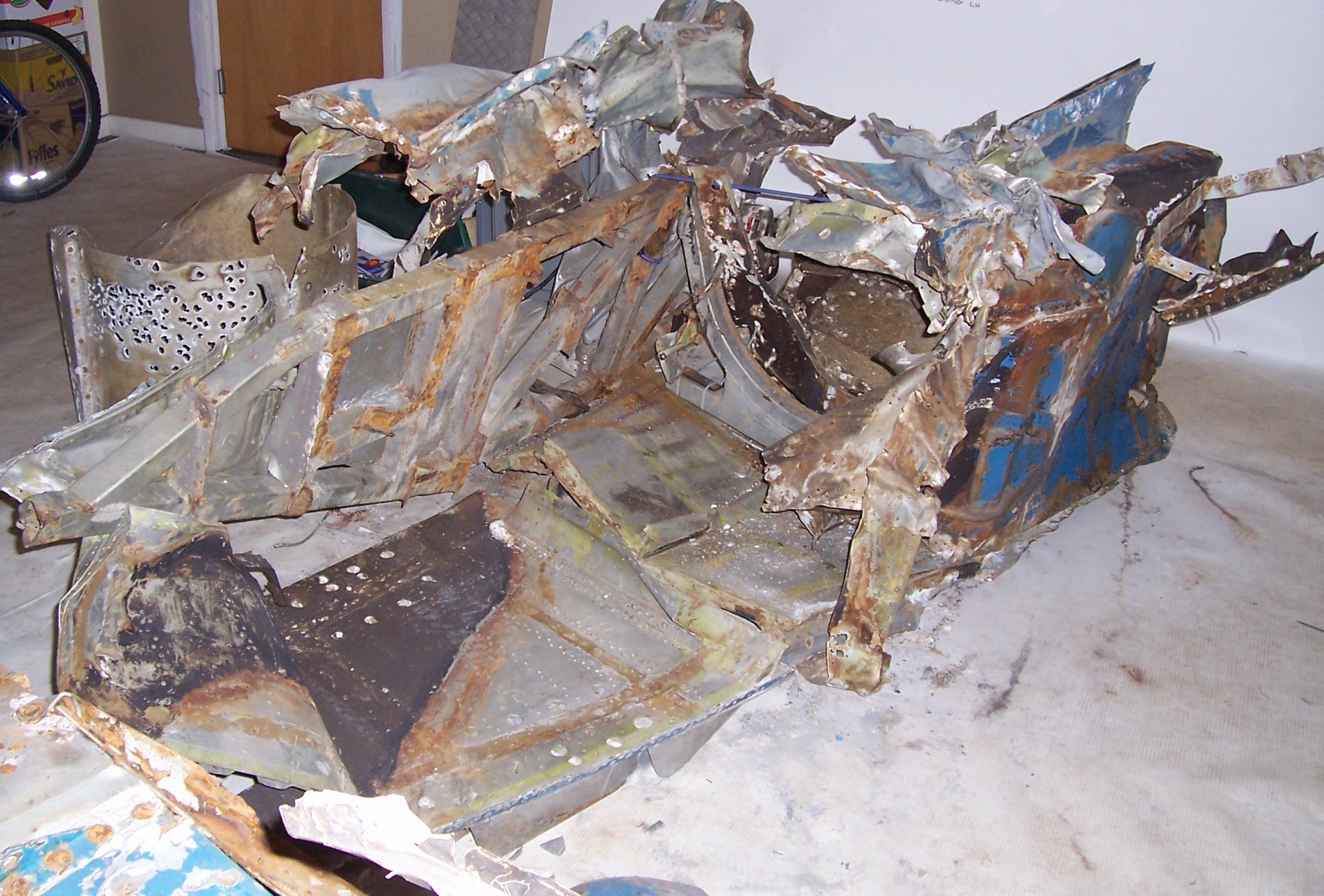
Comparing these two outcomes of the loss and fatality of Bluebird / Donald crashing at 188mph with the previously mentioned drag boat crashing at over 250mph where the driver Bob Pizza survived in his breakaway safety cell capsule with nothing more than a burst eardrum; are to say the least sobering stark comparisons.
For those that ask why we don’t use a military aircraft ejector seat in the cockpit this was something Sergio Abrami who now chairs the UIM Cockpit Committee suggested to us when we first started chatting, to which I informed him that renowned UK ejector seat manufacturer Martin Baker would not support the use of one of their ejector seats for our application. Amongst several reasons for this decision being that we could not guarantee the boat would not be inverted at the moment the seat was fired and if that happened it would fatally eject the driver head first down into the lake. Likewise we could not guarantee the craft would not be orientated facing the shoreline when the seat ejected and in so doing injure or kill a crowd of folk standing there as well as killing our driver in the process.
So with an ejector seat ruled out then our driver cockpit options revert back to either the cockpit being a permanent fixture within the boat hull and fingers crossed hoping there is enough of it left post accident to remain floating long enough upon the lake surface for rescue to arrive and extract the driver before it sinks; or to opt for the breakaway driver safety cell capsule proven over decades to keep drivers alive within drag boat accidents at speeds closest to those of the WWSR.
When we ask the circuit boat racing folk they tend to say have the cockpit stay with the boat. However the speeds of accidents for which the circuit racing drivers have experience of to make that judgement are typically as detailed herein less than 150mph; which considering forces go up at the square of the speed is massively short of an accident / crash occurring at WWSR speeds.
Comparatively when we ask the drag boat racing folk not surprisingly they strongly recommend the breakaway safety cell capsule for our application given they have a vast amount of experience in keeping drivers alive at crash speeds approaching 280mph.
From our perspective keeping the cockpit as a permanent fixture within the hull raises a lot of unknowns in respect of whether an all composite cockpit crashing at or in excess of WWSR speeds would remain intact, to what degree any part of the hull would remain attached to that cockpit and consequentially it is unknown whether the cockpit if intact with any hull attached to it would remain floating long enough for rescue to arrive on scene and extract the driver before it sank taking the driver down with it. This being especially so when considering the WWSR given the forces of impact for a crash at those speeds are so incredibly high.
Two illustrations of composite cockpits that are a permanent fixture of the boat where they suffered accidents at less than 100mph are given below.
Firstly during my meeting with Bob Wartinger at this year’s Coniston Records Week we discussed the incident of a UIM Formula 2 powerboat with UIM passed / approved enclosed cockpit formed solely from composite (i.e. no steel cage) practising out on a lake in the U.K. where it impacted with just the water at a speed thought to be less than 100mph. As a result of that event the composite canopy lid of that cockpit collapsed and impacted upon the driver’s helmet.
Secondly the following video link shows the H1 Unlimited hydroplane U-37 which is able to reach speeds of up to 200mph during racing. In this incident the boat lost a fixed skid fin located just aft of the sponson that with these circuit racing boats is designed to hold the boat in a tighter turning arc than would otherwise be possible with the driver steering the rudder alone. With the loss of skid fin the hydroplane at great speed departed from the course and headed for the crowded pit area whilst slowing down.
At this point the driver J.W. Myers had to make a split second decision as to whether to crash into those people in the pit area or crash into the seawall of the Roostertail Restaurant and heroically they chose the seawall. The speed of impact with the sea wall was recorded by onboard telemetry at 82mph. In so doing JW suffered a broken foot as the composite front of the cockpit being an area that does not contain a steel cage along with composite sponson collapsed from the force of the impact. Of note the size of a H1 Unlimited hydroplane is considerably wide in order to allow it to turn at very high speed without rolling over and the weight of engine is relatively small such that there is a vast amount of floatation with this type of hull.
From the above two illustrations we have composite failures of cockpits fixed permanently within their respective boat hulls at speeds of impact both below 100mph where there was no supporting steelwork behind that composite outer shell. One of these boats was an F2 UIM certified cockpit and the other was a H1 Unlimited hydroplane fully compliant with H1 Unlimited rules.
David’s cockpit on his jet hydroplane SOA2 is formed entirely from composite and built into the hull of his boat as a permanent fixture. When we spoke with David and his team at their visit to us in May and then when they returned for a further visit to us in October, David and his team felt that for their own situation having a composite cockpit as a permanent fixture within the hull was their preferred option for driver safety in the event of a crash.
The decision as to whether to have the cockpit built permanently within the boat hull or to have it as a breakaway drag boat safety cell type, is at the end of the day a decision for each team, especially their particular driver of that jet hydroplane being based upon their own circumstances. In the case of David with SOA2 he has already made the decision to run outside of UIM governance and uniquely he is the designer, builder and driver of his own boat, which allows him complete freedom to do as he pleases in regards to his driver cockpit.
From our own perspective with Longbow the circumstances are inherently different and accordingly it has to be a lot more of a joint decision with our own driver along with our design engineers as well as taking on board as much advice from all quarters to make an informed decision regarding what we agree in our particular case provides the most appropriate solution to our cockpit for Longbow.
When we spoke with Bob Wartinger at Coniston Records Week on balance he favoured the principle of the breakaway drag boat safety cell capsule system over a cockpit fixed permanently within the hull for our specific purpose of an attempt at the WWSR. When we spoke with our engineers and most importantly our driver of the boat Flt. Lt David John Gibbs they strongly favoured the breakaway safety cell capsule system over a cockpit permanently fixed within the hull.
As previously mentioned the drag boat guys who have both built safety cell capsules and survived crashes within them at speeds approaching not a long way short of the current WWSR, felt for our particular application of an attempt upon the WWSR, the safety cell capsule offered a far greater chance of survival than having the cockpit built into the hull of the boat.
When all of these things as outlined herein were jointly considered and discussed amongst ourselves then for our particular case it was the option of the well proven breakaway drag boat safety cell capsule format that has on balance for the driver and the team won the day over a cockpit fixed permanently within the boat hull.
That is not in any way to decry David’s personal choice for his own cockpit with SOA2 but there is certainly a distinct difference of how the cockpits of Longbow compared to SOA2 are designed to perform in the event of a high speed accident. Obviously both teams hope neither of these cockpit types will ever have to be put to the test by way of a catastrophic crash attempting the WWSR. Nevertheless it is something that both teams have had to consider and cater for as a possibility for a jet hydroplane travelling at high speed.
Sergio Abrami Chairman of the UIM Safety Cockpit Committee is a naval architect based in Italy with over 50 years experience in yacht design and who has considerable experience with composites. Sergio and I have become good friends through our ongoing correspondence since he took up that position with the UIM in 2025 and he has been so very helpful in answering our queries to him regarding UIM rules for enclosed driver cockpits.
Other than as previously mentioned Sergio’s recommendation for us to use an ejector seat when he first took up his current position at the UIM was if that were not possible then he recommended us to build our cockpit for Longbow entirely from composite (i.e. with no tubular inner steel cage). We explained to Sergio that this option had already been explored in considerable detail by our design engineer Paul Martin who thankfully is himself an expert in composites. Paul’s career has led him to work upon the F1 McLaren and then Lola race cars, he has been subcontracted as a composite design engineer for military projects to BAE Systems, in addition to undertaking design work for both the Bloodhound and Aussie Invader land speed record cars where each were designed to attempt 1000mph.
In essence for a fully composite driver safety cell capsule for a crash at WWSR speeds one is replacing the internal high tensile steel cage proven over many years to work perfectly well in drag boat racing, by instead using composite internal ribs to carry the impact loads in the event of an accident / crash that normally the steel cage within the capsule would otherwise do.
To manufacture those composite ribs as an integral structural part of a solely composite capsule to work as intended and with complete confidence in their ability to fulfil this design function under the most extreme impact loads during an accident is according to Paul a very difficult challenge indeed to achieve. Additionally with an all composite capsule it would need to mimic the arrangement of the proven main and hinged lid of the high tensile steel cage (including closure locking mechanism to prevent the lid to that capsule not catastrophically and fatally tearing away during a crash.
For an accident / crash at these very high speeds you also have to adequately restrain the driver along with their seat and their breathing air cylinder (the latter weighing around 3kg) which in case of driver and air cylinder would normally both be fixed to the steel inner cage. However in the case of an all composite cockpit driver and air cylinder would be fixed solely to that composite lay up. For driver harness and / or air cylinder to tear out of that composite only structure during a crash at WWSR speeds would not end very well.
They do say and for good reason ‘stray from the proven path at entirely your own risk’. In this regard one might recall a well publicised fairly recent example of a water immersed vessel within which the occupants were killed as a result of a novel composite structure catastrophically failing when it was used instead of industry standard high grade steel for carrying the very high loads in such an application.
Hammering this concern home our design engineer Paul requested some sample composite panels to be made by a third party whereupon he thankfully discovered that their lay up had not been to his specification. As Paul rather aptly quipped, just because it has shiny black carbon fibre to its outer faces unfortunately is no guarantee that it has been fabricated to the designer’s specification.
We trust these points illustrate as to why with Longbow given the very high speeds the craft is being constructed for, we have for our application mirrored the drag boats safety cells and opted for the well proven use of a high tensile steel cage within the driver cockpit safety cell to carry the high impact loads in the even of an accident, rather than opting for a fully composite cockpit structure.
Those following our venture may recall within our previous diary updates that Paul had drafted an initial line drawing concept of that steel cage structure for the cockpit safety cell although this was only the starting point of the design process for this critical element of the boat. What we then required was to tap into the knowledge and experience of several folk who are actively building drag boats, constructing their driver safety cell capsules and speak with some of their drivers including those who had crashed at these incredibly high speeds, thankfully surviving to later recall those events.
In this regard we cannot express how thankful we are to those whom we reached out to within the American drag boat racing community for advice with what we were trying to achieve with Longbow. In particular and as mentioned previously James Brendel widely considered to be the founder of the drag boat safety cell capsule has been so very kind and generous with mentoring us through why these capsules are built the way they are. This being not from some academic design study but from real world cut and try brutal experience and as a result how much ingenuity has actually gone into the current safety cell capsules, how the capsule lid is held down, how they are protected internally from corrosion and how they are released from the boat hulls in the event of an accident, etc.
James describes himself in typical self-deprecating style as the boat builder from hell but that belies his vast amount of knowledge, skills and a lifetime of experience building drag boats and their safety cell capsules that he has so very generously been privately teaching me over the last couple of years. He didn’t have to do that at all given we are designing and building our own driver capsule for Longbow here in the U.K. but bless him he chose to do that in order to help keep our driver alive and he truly has been such a great friend, for whom I really cannot thank enough for the invaluable time and effort he has put into mentoring me on the subject matter.
Drag boat competitor Tyler Speer has also been so very helpful kindly pointing me in the direction of various drag boat racing rules, SFI standards for drag boat driver safety cell capsules and also talking me through his own drag boat from bow to stern. His craft incorporates a different manufacturer of safety cell capsule to that which James produces so that was interesting to compare but he also showed me many other elements of his boat such as its rudder and steering assembly, etc. Tyler also then talked me through why some things are permitted in the lower slower classes of drag boat racing but are not allowed in the more powerful quicker classes which were helpful when applied to Longbow.
Likewise drag boat competitor Tim Campbell generously talked me through his boat from bow to stern and also went through the technical aspects of his safety cell capsule which again was a different manufacturer to those of James & Tyler. He also spoke to us at length about how he had walked away unharmed from a 225mph crash thanks to the safety cell capsule in his drag boat deploying just as it was designed to do, whilst the rest of the craft was completely destroyed:
So with all of this very kind assistance from not just the folk mentioned herein but several others of the drag boat racing community in the USA that knowledge and experience so generously shared to us has been such a great benefit in helping us shape our thoughts and ideas for how we wanted Longbow’s safety cell capsule to be constructed and perform.
However the USA sport of drag boat racing and particularly with regards to their breakaway driver safety cell capsules are as previously mentioned run under their own set of rules completely outside of the international UIM governance where with the latter the UIM enclosed cockpits are a permanent fixture within their boat hulls. Accordingly trying to dovetail a drag boat breakaway safety cell capsule into being compliant with the UIM rules was always going to be somewhat problematic but especially so in our case given the exceptionally high speeds required for an attempt upon the WWSR.
One may see when looking at photos of Bluebird K7 that the driver’s helmet is almost touching the underside of Bluebird K7’s acrylic quarter of an inch thick canopy and its respective overhead locking mechanism; which in no way would now be compliant on safety grounds with the UIM requirement to have a 100mm gap between top of helmet and composite (certainly not acrylic) overhead canopy to an enclosed cockpit.
In the case of American Lee Taylor’s Hustler record breaking jet hydroplane which took the WWSR after Bluebird K7 it is readily apparent that Lee was laid almost horizontal upon his back with his head tilted up to drive that boat, given there was no maximum lay back angle within the rules for cockpits at that time.
With both Bluebird K7 and Hustler the aim was to locate the driver within a narrow low cockpit to help minimise aero drag and hence to go as quickly as possible from the engine power available. Of note both of these boats were UIM compliant when they set their respective WWSR fastest boat in the world records.
Over time the UIM rules for driver cockpits changed such that the minimum distance between top of driver helmet to underside of cockpit structure over that area became 75mm / 3″ which also remains a benchmark minimum distance for drag boat safety cell capsules. The UIM cockpit rules also changed to require the maximum angle a driver could lie back as being no more than 45 degrees.
Since circa 2000 the use of a HANS device by drivers became more common as part of their personal safety equipment. This device is a collar that extends behind the driver’s neck whilst also resting upon their shoulder area. The device is typically made from carbon composite and it attaches to the driver’s helmet with flexible tethers that typically incorporate a quick release feature. The purpose of the device being to help resist excessive forward rotational movement of the driver’s head and neck in the event of an accident / crash and thereby reduce injury.
In 2013 the UIM changed their rules for enclosed cockpits to increase the minimum distance between the top of a driver’s helmet to underside of cockpit structure over that area to be 100mm, so an increase of 25mm / 1″ compared to their previous 75mm minimum distance for this area. This rule change being with the best of intentions and at least in part reflecting their view that the more headroom the better to extract drivers (especially those wearing a HANS device tethering their helmet to their shoulders) as quickly as possible from what may be sinking hull wreckage immediately following a boat crash.
These UIM rule changes in respect of increasing headroom combined with a maximum lay back angle of 45 degrees are of merit as a means to improving driver safety within enclosed cockpits of UIM compliant circuit racing boats, where the speed of those craft is generally well under 150mph. However in the case of Longbow we are aiming for considerably higher speeds and when you start going that fast there are downsides to these rule changes as discussed below, that may in fact put the driver at higher risk of injury or fatality which I am sure the UIM do not wish to see occur as a result of their rule changes when applied to our attempt at the WWSR.
In our case the engines within Longbow are purposely relatively small diameter which allows them to be located low in the hull and thereby helps considerably with stability of the craft at speed. In order to comply with the current UIM maximum lay back angle of 45 degrees for the driver and this increase to 100mm headroom, the tallest part of the driver safety cell capsule for Longbow becomes significantly higher than the engines aft of her cockpit.
When running at speed on her planing shoes air travels both beneath and over the top of the jet hydroplane. So making the cockpit taller to satisfy these UIM rule changes has consequences according to Bernoulli’s principle which means this air travelling over the top of a higher cockpit has to go quicker than a lower cockpit to keep up with the air passing beneath the hull. In so doing this creates an increase in the low pressure zone above and just behind the cockpit which in turn creates an upward force (lift) towards the front of the boat. If this issue is not adequately addressed then a taller cockpit would consequentially increase the risk of Longbow blowing over and crashing at very high speed.
Additionally the higher the cockpit is then the higher the craft’s centre of gravity becomes which on a boat with a relatively narrow beam (width) as in the case of Longbow increases the risk of the craft rolling over whilst travelling at high speed.
Whether on the grounds of safety when travelling at these very high speeds the UIM would allow us to lay the driver back at a greater angle and / or reduce headroom to address the stability issues outlined above for our particular application we will have to see. However just like an aircraft manufacturer our primary aim with running at these very high speeds should be to avoid an accident occurring in the first place by having stability of the craft as the priority.
Delving further into the UIM rulebooks we note that they require an external canopy lid hinge made from stainless steel, with a 6mm diameter quick release pin that can be pulled by the driver from inside the cockpit or pulled externally by the rescue team out on the lake. Upon removal of the pin it separates the hinge into two parts, one side remaining attached to the canopy and the other to the rest of the cockpit. This arrangement aiding the extraction of the driver as quickly as possibly from a cockpit integral to the hull and hence post accident which might be in the process of sinking. Again we remind the reader that the majority of UIM boats do not exceed 150mph.
Rather interestingly the H1 Unlimited hydroplanes where those craft run at speeds up to 200mph and who operate under their own set of rules outside of the UIM have much more substantial hinges that are completely internal to their cockpits and have no external quick release pins to separate those hinges. The reason being the faster speeds of these craft mean the hinge structure needs to be stronger and more protected to cope with the forces it has to endure in the event of a high speed accident / crash situation.
Likewise with drag boat racing their safety cell capsules also has internal more substantial hinges to cope with the even greater forces they have to endure in the event of a high speed crash where the craft may be running at speeds of up to just under 280mph.
With Longbow given the tremendous forces involved for an accident at speeds in the order of the WWSR, the logical design choice for our particular application is to follow the examples of H1 Unlimited hydroplanes and drag boat safety cell capsules by way of having a substantial hinge internal to the cockpit since the last thing we want is for the canopy lid to be ripped off in the event of an accident due to a snapped external hinge failing.
When it comes to mounting the driver seat harness to the safety cell capsule the drag boats have a preference for wrapping the harness webbing around the high tensile steel tubular cage inside the cockpit rather than clipping the harness to eye bolts. The reason for this is not surprisingly one of greater safety for the driver as illustrated below:
|
Feature |
Wrap-Around Roll Cage |
Eye Bolt / Bolt-In |
|
Tensile Strength |
Superior. The load is borne entirely by the structural tube. |
Lower. Limited by the sheer/tensile limits of the bolt thread and hardware. |
|
Failure Points |
Virtually none (assuming the webbing is high quality and wrapped correctly). |
Thread stripping, bolt shearing, or the mounting tab bending / tearing under load. |
|
Alignment & Load Path |
Perfect. Webbing naturally self-aligns perfectly straight with the direction of the impact force. |
Requires precise alignment. If the load pulls sideways on an eye bolt, it creates massive bending leverage. |
|
Ease of Adjustment |
Requires patience to thread and lock down tight. |
Easy to clip in or bolt on. |
The UIM rules discusses driver harnesses being attached to eyebolts that in turn are attached to the all composite cockpits they typically have as a permanent fixture within their hulls. Given the tremendous forces involved during an accident at the exceptionally high speed we wish to run Longbow then we have chosen to follow the drag boat convention of wrapping our driver harness webbing around the high tensile steel cage within the cockpit.
Next we come on to the UIM rules requiring drivers of enclosed cockpits to have a 180 degree field of vision and for the enclosed cockpit to be fitted with mirrors for the driver to see rearwards. We appreciate both of these requirements are helpful safety measures when you have several boats racing in close proximity to each other and obviously in such a situation the drivers are trying to avoid running their boats into each another.
However when you look at the drag boats you will not see mirrors attached to the safety cell capsules because in the first instance drag boats are designed to run in a straight line down their own lane and secondly protruding mirrors would likely be ripped off the capsule during a very high speed accident and in so doing compromise the outer composite shell of the capsule.
In the case of Bluebird K7 and the current record holder Spirit of Australia both of which were UIM compliant at the time they set their records, these craft had no mirrors fitted on either side of their driver cockpit as they would be useless in that they would only provide the driver with a view down the jet engine air intakes. Likewise with Longbow the same issue would apply so for this and the other reasons previously referred to we will not be fitting mirrors to the driver safety cell capsule.
On the point of the UIM rule stating the driver must have a physical visual 180 degree field of view then this requires the windshield having to extend rearwards far enough on either side of the driver to facilitate that 180 degree field of view and likewise the internal tubular steel cage not to be in the way of that 180 degree field of view.
The position of the jet engine air intakes upon the quickest boat in the world Spirit of Australia being either side of the driver cockpit do not allow the driver to have a 180 degree field of view and the craft was UIM compliant when it obtained its record. The position of the twin jet engines, one on either side of the cockpit of the quickest car in the world, Thrust SSC does not allow the driver to have a 180 degree field of view.
There was no live video feed into the cockpit from cameras mounted on either the quickest boat in the world or quickest car in the world to provide rearwards and 180 degree field of view.
In the case of drag boat capsules the windshield is structurally weaker than the composite outer shell of the driver safety cell capsule and so to take that windshield so far back as to provide a 180 degree field of view as per UIM rules would for our application compromise the safety of the driver especially in the head area in the event of an accident / crash. Likewise to have the high tensile steel tubular cage positioned in a way as to provide a 180 degree field of view for the driver would also compromise driver safety especially in the head area.
Current drag boat safety cell capsules have over the years reduced how far back on either side the windshield comes and the height of that windshield in order to improve the strength of the capsule. Also the steel cage over the driver’s head area now extends into what would otherwise be that 180 degree field of view area. These changes to drag boat design having been introduced purely to improve driver safety for crashes at these very high speeds. We would likewise wish to mirror these improvements to driver safety with our safety cell capsule given the very high speeds we wish to run Longbow.
When a driver of a car or boat is sat still they typically have a 180 degree field of view but as speed increases your brain struggles to process peripheral details because not surprisingly your mind is focusing upon what is directly ahead of you. Typically at 20mph your field of view has already dropped from 180 degrees to only 100 degrees. By 40mph it is down to 70 degrees and by 90mph it is typically reduced to as little as only an 18 degree field of view because the brain is simply prioritising concentrating upon looking so much further ahead in the direction of high speed travel.
Yes you can move your head a little from side to side within the constraint of wearing a HANS device where you helmet is tethered to your upper body, however when travelling at the current record speed of 317mph you are covering 465 feet (approximately the length of one and a half football pitches) per second and accordingly it only takes several seconds to travel through the one kilometre timing trap.
You might just want to try counting your way up to seven seconds to appreciate that running the boat at the speeds we are aiming for is perhaps neither the time nor the place to be looking sideways to wave at family and friends on the shoreline when the driver should instead be focusing upon what is ahead of them and what the boat itself is doing.
In our case the UIM has stated to us that instead of mirrors and a visual 180 degree field of view through a windshield they will instead permit us to use a video camera mounted on the boat to provide views rearwards and a 180 degree field view to a live feed monitor within the driver cockpit. However this easement is not what the UIM written rule actually says and so such an easement for our case sets something of a precedent for the UIM to allow us certain exemptions of their written rules for matters of safety in the context of an attempt upon the Outright World Water Speed Record (WWSR).
In order to fit a secure live feed video monitor within the cockpit of Longbow it would need to be wirelessly connected to the external camera otherwise it comes with a bunch of wires that would have to separate as the capsule is ejected out of the hull in the event of an accident. However even a wireless monitor rigged specific for that purpose in the cockpit brings added complications.
The monitor would need to be in the driver’s field of view if it is to serve its purpose, otherwise it is just there for the ride and as one can see from the previous discussion the driver’s field of view becomes narrower the faster one travels and the time to look around at WWSR speeds is of extremely short duration. Also one has to be mindful of it being an additional item that requires strong enough mounting within the capsule to prevent it breaking free in an accident to then batter the driver with as their capsule is ejected out of the boat and tumbles across the lake surface. There is simply no place within that driver safety cell capsule for anything which is not absolutely essential as it is just dead weight, when for the reasons stated later within the update weight of the capsule becomes a critical limiting factor
Generally and it may be obvious to say, the quicker a person travels be that on a motorbike, in a train, sat in a car, airplane or boat then the greater the risk of not surviving an accident / crash if such should occur.
So let us imagine that a pilot and passengers are taking a flight across the ocean seated comfortably within their commercial aircraft (i.e. no ejector seat and no parachutes) where the plane has a weight the same as Longbow. Why does the Civil Aviation Authority (CAA) or Federal Aviation Authority (FAA) not demand from the aircraft manufacturer that the integrity of the cockpit to this aircraft have to remain intact for it crashing into the ocean at 400mph?
Well perhaps it is simply because that crash of the airplane into the sea at 400mph where the water simply cannot move out of the way quick enough equates to the pilot and passengers experiencing a force of roughly 650G so if the people inside each weigh 180 pounds they are going to feel a force upon them of 650×180 = 117,000 pounds (53 tonnes) which guess what Sherlock, it is absolutely fatal.
This being the case the aircraft manufacturers do not build cockpits and planes that will remain intact for a crash into the ocean at 400mph as it is simply pointless but instead take the common sense approach of putting their time and effort into developing the aircraft so it reliably can undertake the journey without crashing at all.
People may quote the highest G load ever survived by a person coming to a sudden stop in an accident as 215G which momentarily occurred in a racing car crash with a frontal impact into catch fencing by racing driver Kenny Bräck in 2003. The doctor on scene at that accident was apparently collecting bits of bones out of the wreckage labelling them left and right ankle. This value of 215G however does not provide the full picture for which you may find the following to be of interest:
|
Force Direction |
Sustained Danger Zone (Seconds) |
Instantaneous Crash Limit (Milliseconds) |
Primary Cause of Death |
|
Forward/Backward (+/- Gx) |
20G to 30G+ |
100G to 200G+ |
Organ tearing / Internal bleeding |
|
Downward (+Gz) |
10G to 12G+ |
30G+ |
Brain hypoxia (oxygen starvation) |
|
Upward (-Gz) |
5G+ |
15G+ |
Brain haemorrhage / Stroke |
From the above one may see that a driver only has to suffer a force of a mere 5G upwards for a few seconds duration for it to be fatal. Also whilst Kenny Bräck was extremely lucky to survive his milliseconds forward impact of 215G, this is massively lower than the 650G impact load of a boat crashing nose first into the water at 400mph.
Survivability with an unpredictable crash scenario that everyone hopes will never happen is as seen from the above very much a lottery. If the boat crashed for example by blowing over as previously discussed, then with the right cockpit and a great deal of luck then the G loads may just be within a range that was survivable. However in some other crash scenarios the strongest capsule in the world doesn’t mean a thing when the G loads alone are more than sufficient to have (as quoted by the late great British steeplejack Fred Dibnah) ‘half a day out with the undertaker’,
We have generally tried to marry the UIM cockpit rules where applicable with those of the sport of drag boat racing, the latter of which is undertaken completely outside the governance of the UIM. However where there was inevitable differences between these two ruling bodies and we felt the drag boat safety cell capsule format gave us what we consider to be a safer option for our driver in consideration of the exceptionally high speeds we are wishing to run Longbow; then it is the drag boat format that we have adopted in preference to the UIM.
We feel this action is justified given there is no getting away from the fact that it is the drag boat driver safety cell capsules which have proven time and again to remain intact at crash speeds well beyond those which any current UIM boats have crashed and their cockpits remained intact with the driver surviving the incident.
Fortunately Bob Wartinger knows the drag boat safety cell capsule builder James Brendel rather well and in our conversation at Records Week, Bob said that he was pleased that James had been privately mentoring us as an invaluable aid for what we were trying to achieve with Longbow. During my conversations with Bob he was of a view that UIM 601.01 provides an avenue for us to make our case for why we have taken the design path that we have where safety of the driver for this particular application was our priority.
Whilst publicly the venture over the last several months went somewhat quiet, I can assure you that in private it was anything but, with face to face or video meetings that have taken place literally week after week, month after month and in particular Paul Martin, and especially Chris Fleet, James Hodgkiss and Jack Horsfall working so very hard on the cockpit design in their spare time to make the venture happen.
The following photos show some of the guys from AFD Systems along with our good friend David Heap at one of the many technical meetings that have been going on with Longbow since our last diary update.
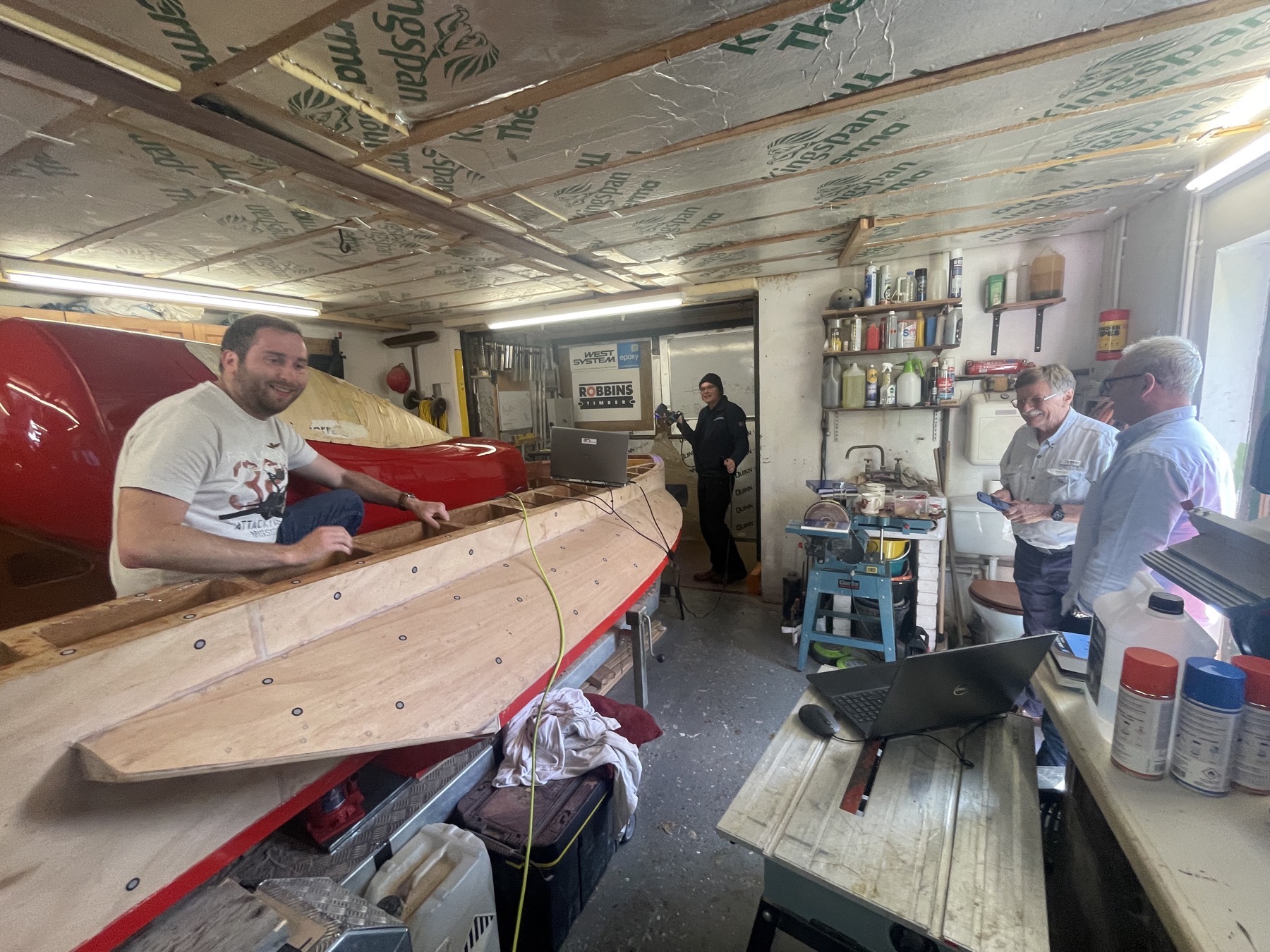
This UIM rule 601.01 has caused such a headache to try and comply with and in the end we have to be realistic about the extent to which we are able to go down that road because there is clearly a practical limit of what we can achieve in that regard.
What I mean by that is there an inherent design trade off when UIM rule 601.01 is applied to Longbow in that the driver safety cell capsule located towards the front of the boat has to be just light enough for the craft to still be able to get up onto her planing shoes to work as intended, otherwise if that cockpit is too heavy the front of the boat will just plough along and be totally useless at achieving what she was built for by way of rising up onto her planing shoes and running at high speed. Also the driver safety cell capsule has to be light enough to remain floating with driver inside in the event of a major accident where it is ejected from the hull, as opposed to being so heavy that if ejected from the boat hull in an accident it then sinking like a stone with driver inside.
However the design engineers also want the driver safety cell capsule to be as strong as it can be and for that read consequentially heavy in order to endure the impact loads they have in mind during a crash situation.
The difficulty is finding the sweet spot where the boat works as intended, the capsule in the event of an accident floats as intended and the capsule is strong enough to at least given the driver a sporting chance of survival which has to be an improvement than when previous WWSR craft crashed at very high speed.
Also we are in danger of going round and round in circles trying to comply with this UIM rule 601.01 to such an extent that we end up with what is sometimes referred to as analysis paralysis, polishing the cannonball, or nirvana fallacy which are all various terms to describe pretty much the same thing. That is being in a situation where we want to constantly refine the cockpit design, add features and are continually aiming without end for a risk free solution that simply does not exist as is readily apparent from the discussion herein.
So in the end we have to make a judgement call and say that is what we are going to build by way of driver cockpit. Whether the UIM and its U.K. national affiliated BPBA accepts the breakaway safety cell capsule we are going to fabricate as generally compliant (with them permitting certain exemptions on grounds of driver safety for the reasons stated herein) we will have to wait and see, because currently breakaway safety cell capsules are completely alien to boats running under UIM governance.
However given we had to have a plan B if the UIM and its U.K. national affiliated BPBA do not accept our safety cell capsule as compliant with their rules, then the following action was taken by ourselves earlier this year.
For craft wishing to run at speeds in excess of 10mph upon Coniston Water which are not compliant with current UIM rules and hence are unable to enter the Coniston Records Week event, the Lake District National Park Authority (LDNPA) provides a pathway for that to occur under strict conditions via an application to them for consideration upon merit.
It was through such means that Bluebird K7 which is not compliant with current UIM rules was permitted by the LDNPA to exceed the 10mph speed limit upon Coniston Water earlier this year.
Prior to that event we had contacted the LDNPA to seek clarification from them upon certain matters including as follows:
1. If we wished to run Longbow upon Coniston Water at times other than Coniston Records week would that in principle be permitted by the LDNPA irrespective of whether the cockpit of the craft was UIM compliant or not.
2. In consideration of the exceptionally high speed the current WWSR is and David Warby first putting his jet hydroplane upon the water in Australia back in 2017 followed by a protracted program of development since that time, now up to around 280mph; it is readily apparent that if one is to do this with a safety first approach then to have any hope of success it is not possible to simply put a new craft upon the water and then immediately following that make a credible attempt upon the current WWSR.
Accordingly would the LDNPA allow us to run Longbow upon Coniston Water upon multiple occasions under the umbrella of that all being part of a protracted period of development of the craft leading to a credible attempt upon the Outright World Water Speed Record (WWSR) and irrespective of whether that was sanctioned by the UIM or not.
After a period of consideration upon these points by the LDNPA in consultation with their legal department we were pleased to receive a written response from the LDNPA stating that they would in principle allow Longbow to run outside of the annual Records Week event upon Coniston Water irrespective of whether the cockpit of Longbow is UIM compliant or not.
The LDNPA also wrote stating that they would in principle allow Longbow to run upon multiple occasions at Coniston Water as part of a program of development for the jet hydroplane leading to a credible attempt upon the Outright World Water Speed Record irrespective of whether the cockpit is UIM compliant or not and irrespective of whether the UIM sanctioned the record attempt or not. Notwithstanding the aforementioned points such consent in principle obviously being subject to the LDNPA application process to exceed 10mph meeting their requirements.
Following receipt in writing of this positive news from the LDNPA we had a meeting at the end of July with Sara Spicer and Derek Jones of the LDNPA which was both productive and positive. At this meeting the subject of Longbow and indeed other jet hydroplanes running upon Coniston Water outside of the annual Records Week event and where applicable outside of the UIM governance was further discussed in some detail. In addition and critically important one must also appreciate that this positive news from the LDNPA also sets a legal precedent should we wish to apply to respective third parties to run Longbow on other bodies of water within the U.K. for example some of the lochs in Scotland.
Upon reflection looking back at how this UIM rule 601.01 has caused us so much engineering analytical work in respect of the driver safety cell capsule for Longbow and consequentially very frustratingly held up completion of the craft over the last couple of years we feel that it would be grossly unjustified to suggest that our engineers and indeed myself had not put enough research, thought, time and effort into the cockpit for the craft. Our priority has always been and remains doing what we are practically able to achieve within our means to reduce risk to our driver undertaking an inherently dangerous extreme sport they have chosen to participate in.
So folks here it is Longbow’s cockpit for you to have a first look at as we go public with it showing you the stage which it is currently at.
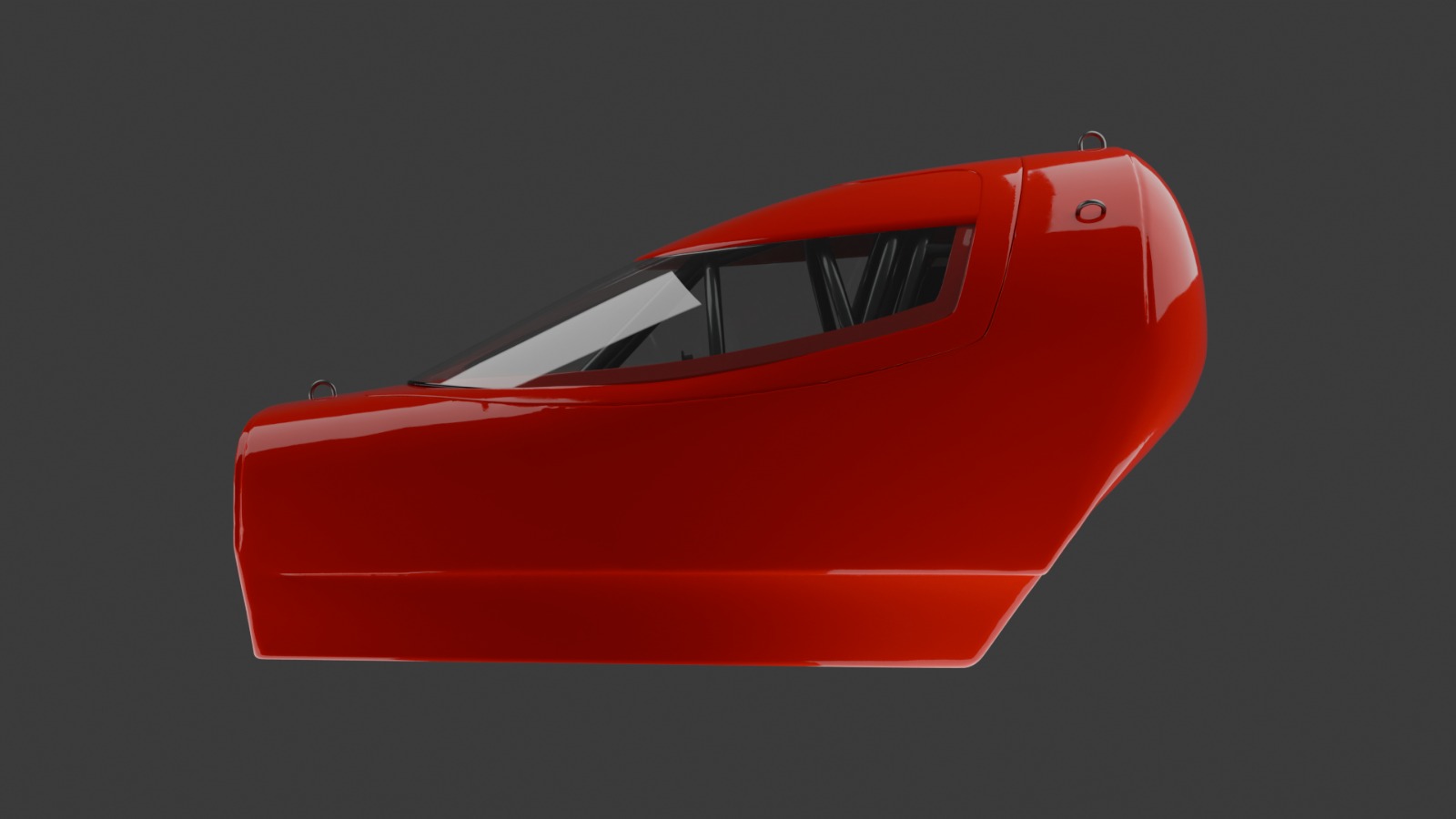
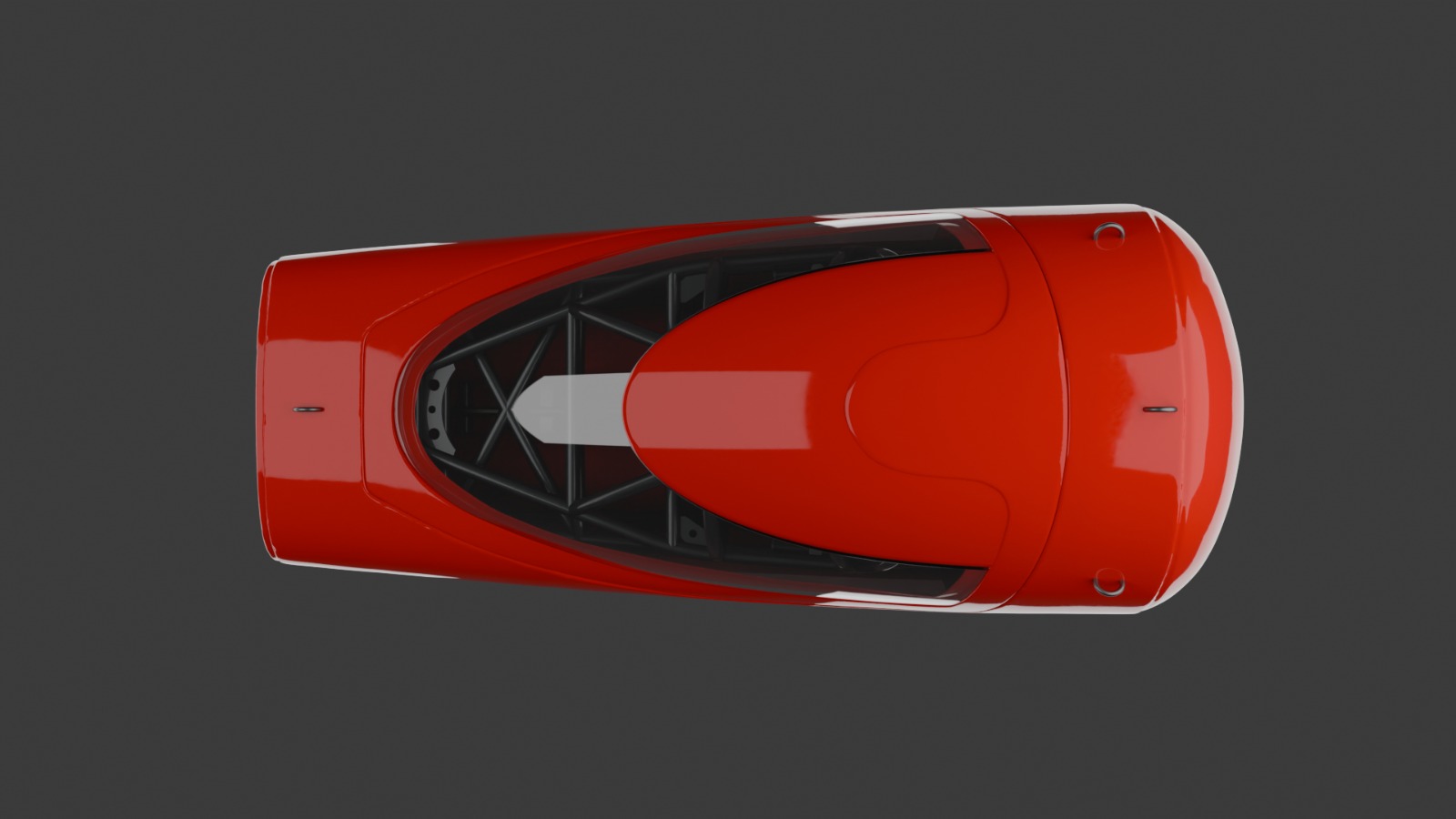
This is not an AI generated concept, it is CAD rendering direct from our current 3D CAD design model produced by our engineers at AFD Systems and satisfies the UIM internal minimum distances for legroom, shoulder and seat widths, opening to get out of the cockpit, top of helmet to steel cage headroom and maximum driver lay back angle of 45 degrees. The capsule at this stage also provides the driver with 180 degree field of view as required by the UIM.
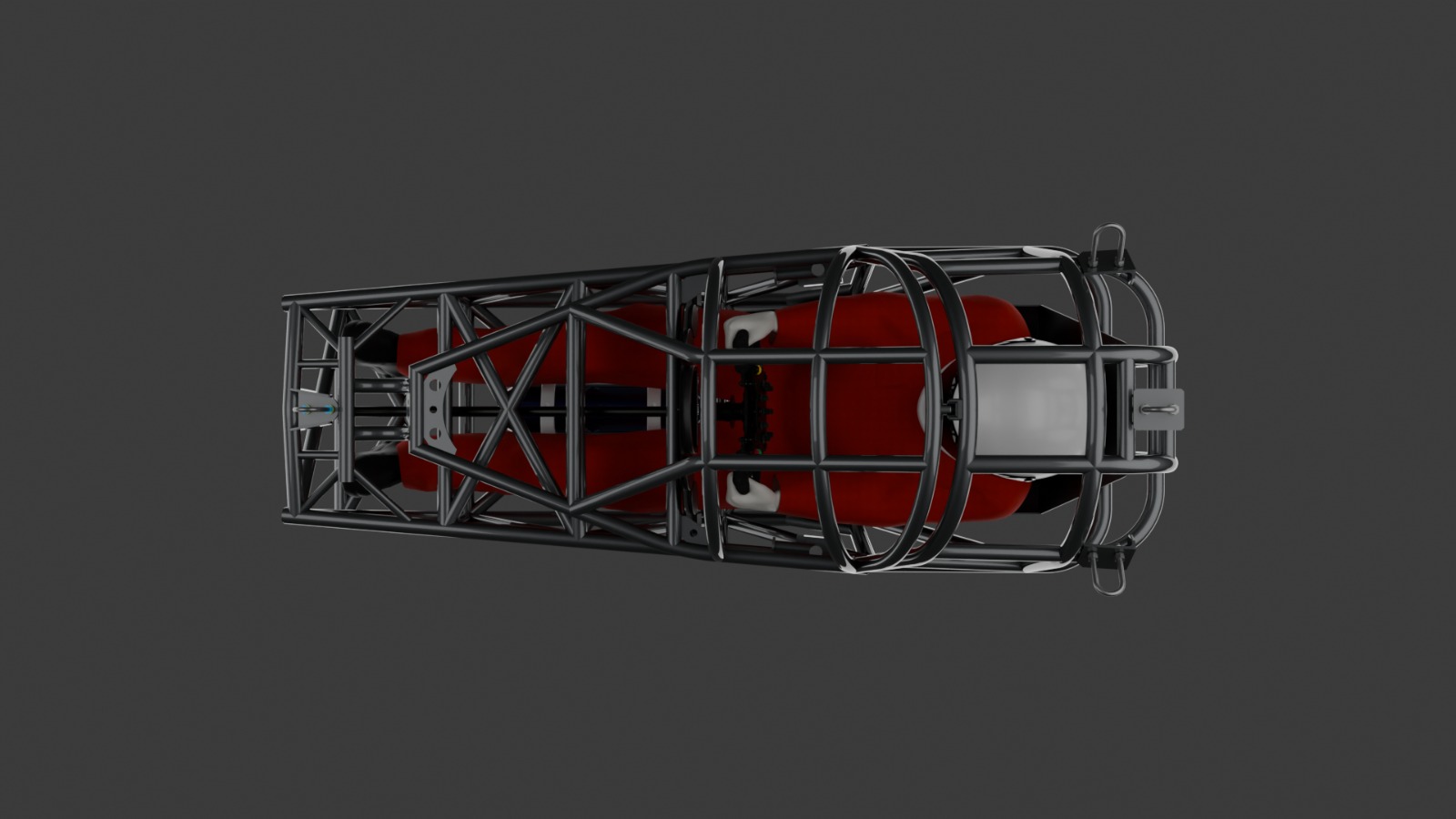
The high tensile steel cage within the cockpit extends into the cockpit lid to support that element of the capsule for which when closed that lid is restrained at several points into the main cage structure. The hinge for the capsule lid is internal to provide the protection to it that we deem necessary for the forces it is designed to withstand in the event of an accident. The outer composite shell is specified to meet our four point bend test requirements and to work in conjunction with the inner steel cage to carry the impact loads if it were subject to a crash at high speed.
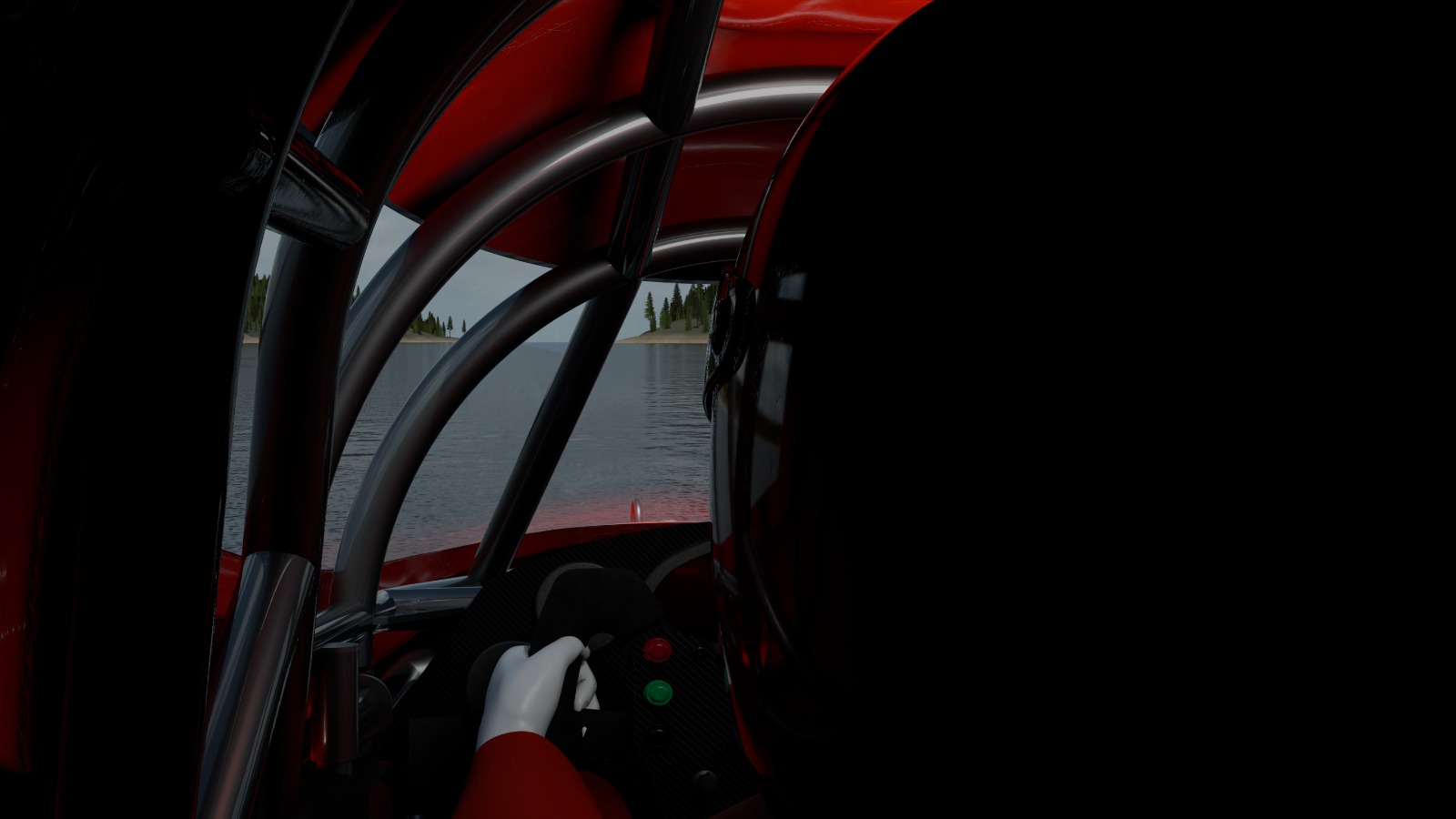
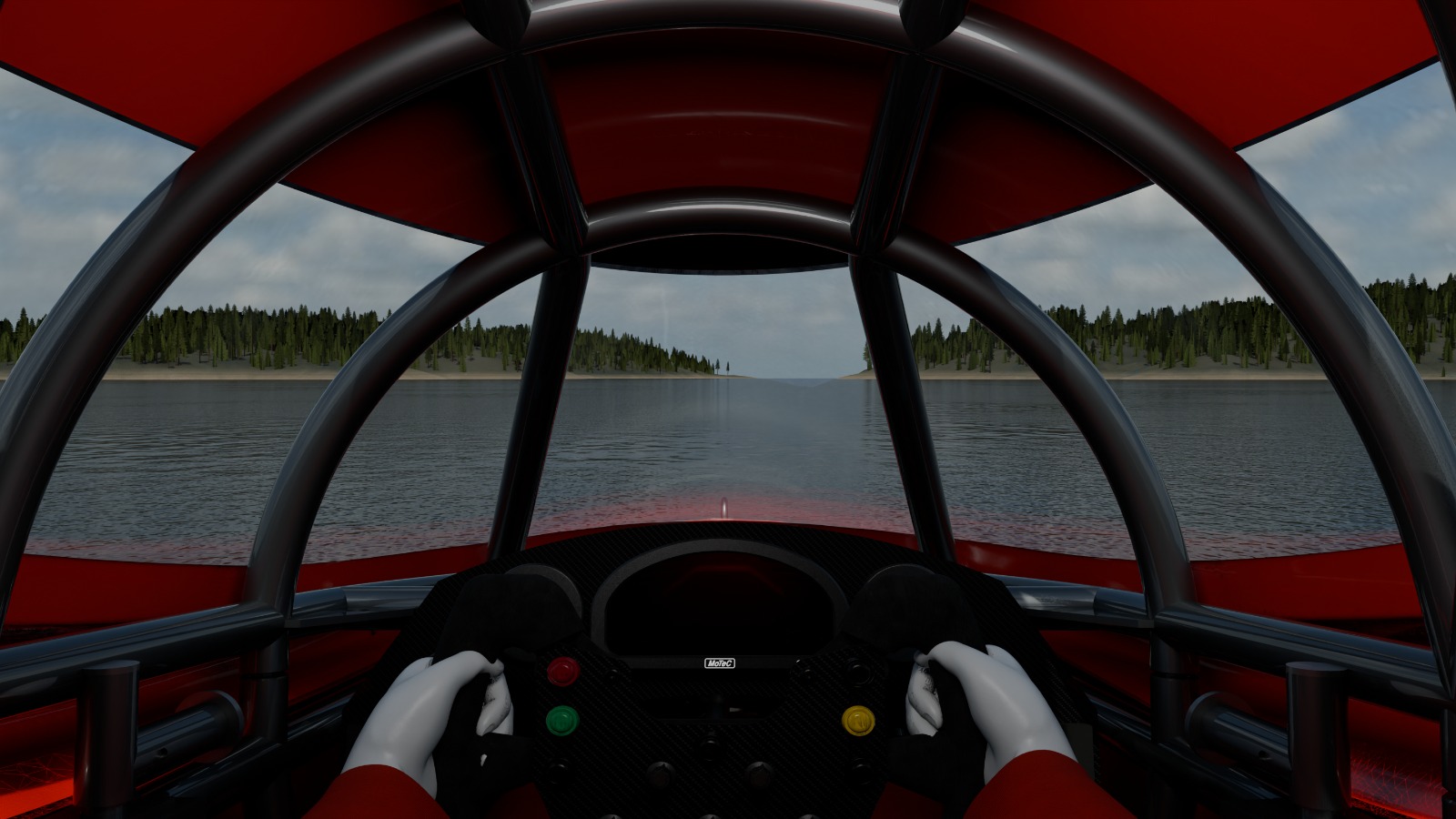
At present and not shown herein the guys at AFD Systems are working upon the finer details of canopy locking mechanism (accessible both internal by driver and external by rescue), along with capsule release mechanism and steering shaft emergence through front of capsule. This design work being a development of my own extensive 2D CAD work upon this mechanism. Meanwhile Paul is working upon testing core samples for the cockpit to ensure actual performance values meet or exceed theoretical values. There is still some refinement to optimise the capsule for its installation within Longbow’s hull and to reflect any easements the UIM grant in respect of the matters discussed herein but I hope you can see that we are at long last getting there with this critical element of the jet hydroplane.
As part of the driver cockpit design study there are a whole bunch of thanks that I feel it is now appropriate to go out to for those who have helped with that process, commencing with folk who have provided us with access to their huge amount of archive material that they have collated over decades regarding the WWSR and various high speed hydroplanes. For example but not limited to Steve Holter, David de Lara, Keith Mitchell, Brian Millin, Franklin Ratliff, Geoff Holme, Don Baumera, not forgetting those no longer with us such as Fred Blois and of course the great John Paramore for whom we are most grateful.
Then there is the following who have all contributed technically in one way or another with varying levels of input:
- Design engineers Paul Martin, and from AFD Systems: Chris Fleet, Jerrod Hartley, James Hodgkiss, Jack Horsfall, Andrew White, Joel Durkin, Phil LeMottee, Tom Baynes, Martin Stones, Bailey Black, Tomas Halliwell and Adam Snelson.
- Mentoring from David Warby & Peter Jarrett
- Mentoring from James Brendel, Tyler Speer, Tim Campbell & others of the drag boat racing community.
- Guidance from Sergio Abrami of the UIM Safety Cockpit Committee.
- Guidance from Tom Stanley, Bob Wartinger, Fred Hauenstein of the UIM.
- Mentoring from Scott Raney owner of the U-11 H1 Unlimited hydroplane.
- Technical discussions with Chris Loney of the BPBA / UIM.
- Historic mentoring from the late Doug Ford Chief Engineer & Head of Safety for H1 Unlimited.
- Mentoring from Steve Compton with his vast experience of hydroplanes.
- Historic mentoring from the late Chartered Engineer Ken Wheeler, MD for Norris Brothers who designed Bluebird K7.
- Guidance from Chartered Engineer Rob Irvine (former Chair of Osprey Powerboat Rescue).
- Input from Longbow’s driver David-John Gibbs (DJ), of the RAF whilst he continues his military career of examining other pilots, performing airshow acrobatics and undertaking test pilot training.
On a personal note and far more important than Longbow I am pleased to say that since our last update our two year old granddaughter, Annabelle is now able to drink and eat on her own such that her feeding / fluid tube into her stomach was able to be removed earlier this year and she is now making fantastic progress. In addition we have our 4th and 5th grandchildren due to be born in January and March next year so the family are very much looking forward to that. Puppies have just been born here too from my son Rob and his wife Cait’s miniature poodle if anyone is thinking of having a joyful four legged friend addition to their lives and at the moment I am heavily involved with renovating their newly purchased large house so they are temporarily living here whilst their place is currently a building site!
Well if you managed to read all the way through to this and my winding up of a very long diary update, well done you and please accept my sincere apologies for it being so protracted for which I hope you may have found at least some of it of interest and an explanation of where we now are with the project. At least with the design phase of the driver safety cell capsule now finally getting there I can start to turn my attention to the rest of the build of Longbow. Hopefully it won’t be as long to the next update of the project and if you have not already done so please follow our Longbow jet hydroplane page upon Facebook for further updates as the project develops.